Families' nightmare fight for justice in Austria child sex cases / Photo: Joe Klamar - AFP

When her three-year-old son Elias told her that his father, a child psychiatrist, had abused him, Alina thought she would quickly find support to protect her child.
But what ensued was a shocking odyssey through Austria's legal system, where she found those in powerful positions protected their peers, while she faced kidnapping accusations when she tried to keep her son safe.
The social worker's legal battle only ended when her husband committed suicide three years later and another minor filed a sexual abuse complaint against him.
"Sadly, he protected my son by killing himself. No one else did," Alina told AFP.
Elias and Alina's nightmare is by no means unique.
In another Austrian case examined in detail by AFP, doubt also benefited the alleged paedophile, according to court documents.
Austria has been hit by a procession of high-profile paedophilia scandals, most notoriously that of Wolfgang Priklopil, who abducted 10-year-old Natascha Kampusch in 1998 and held her for eight years in his basement.
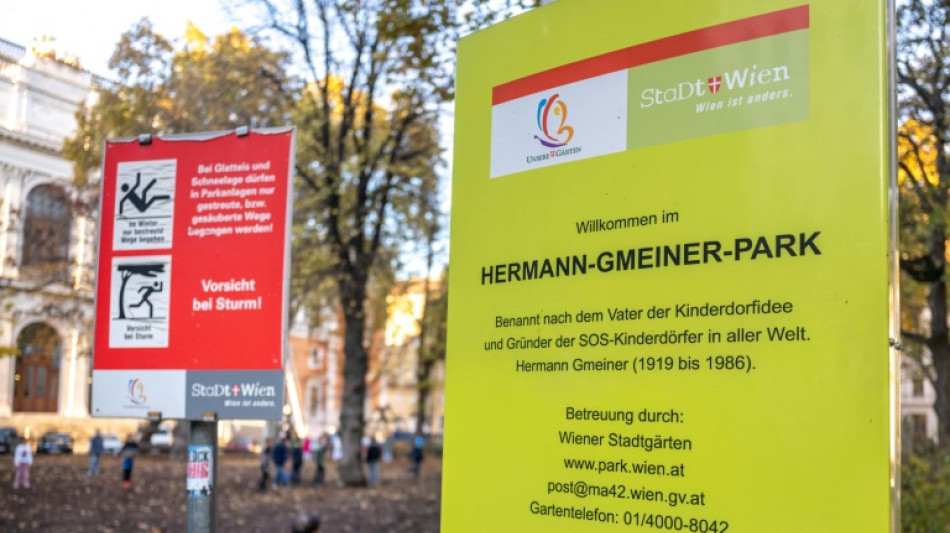
The latest broke in October, when Hermann Gmeiner -- long celebrated for helping orphans with his charity, SOS Kinderdorf Austria -- was accused of abusing children from the 1950s to the 1980s.
While he is now dead, several people who worked for the NGO are being investigated.
- Wall of silence -
A similarly all-powerful man protected by his fame inspired Austrian Nobel literature prize winner Elfriede Jelinek to write an opera about the child psychiatrist and serial abuser Franz Wurst two decades ago.
The well-known paediatrician was convicted in 2002 for sexually abusing more than 80 children. Such was his control over his victims, he even used one of them to kill his wife.
But theatres refused to stage Jelinek's work, leaving it to lie in a drawer unpublished.
Despite the headlines generated by the recent Gmeiner case, victims' groups say a deep-seated reluctance to tackle the reality of the problem persists.
When Alina -- whose name AFP has changed to protect her son's identity -- filed for custody after her son told her about the abuse in 2000, the judge had to rely on a child psychiatrist's report for his judgement.
He recommended the courts "grant the father extensive visitation rights, given his profession".
He even advised that after a trial period, overnight stays at the father's home be authorised, without ever having met him.
Alina claims several of her husband's colleagues knew he was a paedophile.
In his diary, consulted by AFP, Elias's father wrote that he wished to become a child psychiatrist to get "close to children".
- 'Crushed' -
A senior child psychologist told AFP she has repeatedly come up against abuse of power by child psychiatrists in Austria.
A child's word carries little weight when hard evidence is lacking and the accused parties deny wrongdoing, she said.
She cited another case in which a doctor ruled out rape in his expert's report, even though "the facts were staring you in the face".
And she said the psychiatrist who did the report in Elias's case once wrote to the group she worked for calling for discretion in another incest case involving a member of the traditionalist Catholic organisation Opus Dei.
The psychologist said those who try to speak out expose themselves to defamation suits.
The wall of silence this creates has "crushed" families who bring complaints of abuse, she told AFP, often causing them to give up their fight for justice.
Victims' support group StoP said that "something is not working with the rule of law" in abuse cases in Austria, "as recent examples show", including the SOS Kinderdorf scandal.
It said "perpetrators are being better protected than children".
The group said that in criminal as well as custody cases, "the violence perpetrated against children and their mothers is not taken into account."
And it called for the judiciary to get specific training for such cases.
- 'Gaps' -
One Austrian grandmother fought tooth and nail to ensure her son-in-law would never be allowed to be alone with his twin boys, who began to speak of his abuse before they were even three.
They also described how they were repeatedly photographed in sexualised positions by their father in the presence of other men.
Yet courts ordered the twins to be returned to their father despite unequivocal expert reports, seen by AFP, and the boys' own testimony.
Instead it was the twins' mother who was convicted by a court abroad for failing to return the boys to their father after she went into hiding with her kids.
The proceedings were long, complex and costly, with the case passing through several judges' hands.
One Austrian judge questioned the mother's evidence, interrupting her when she began recounting what the boys had experienced.
"Were you there?" he asked.
"No one was there," he declared.
Stunned by his intervention, the grandmother later discovered that a few years earlier, the same judge had been arrested after being caught in the toilets of a swimming pool with a 13-year-old boy.
Placed in pre-trial detention and then charged, he defended himself by claiming he believed the boy was 14, the age of consent in Austria.
He was acquitted and promptly returned to the bench.
Austrian lawmakers urged the government in January "to identify the legal gaps in child protection and to close them as quickly as possible", with "80 percent (of abuse) occurring within the immediate family circle".
T.Quinn--IP