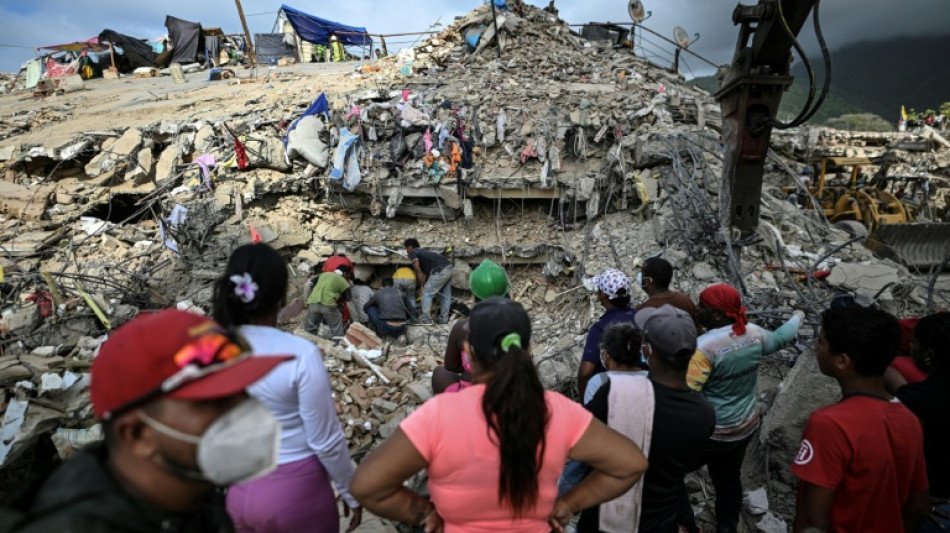
World Bank estimates Venezuela quakes caused $19.6 bn in damage / Photo: Juan BARRETO - AFP

Twin earthquakes that devastated Venezuela last month caused at least $19.6 billion in direct physical damage, the World Bank said in an estimate Thursday, stressing the need for a rapid increase in public reconstruction funding to avoid lasting economic effects.
At least 5,398 people were killed in the June 24 earthquakes, with hundreds of buildings destroyed, particularly in the hardest-hit state of La Guaira in the country's coastal north.
At least 16,740 people were injured, and unofficial estimates put the number still missing in the thousands. The United Nations estimates more than a million people are in need of immediate humanitarian aid.
The World Bank's assessment focused only on damage to buildings and infrastructure.
Direct damage to residential buildings came in at almost half of the assessed total at $9.3 billion.
Non-residential buildings suffered $5 billion in damage and infrastructure faced $5.2 billion in losses, with dozens of hospitals and hundreds of schools badly damaged.
An early UN damage assessment, released about a week after the quakes, estimated direct physical damage from the disaster was far higher, putting it at $37 billion.
La Guaira and the district encompassing the capital Caracas were the hardest hit, accounting for roughly half of all damage, according to the World Bank. In La Guaira, the Bank estimated one in five homes was destroyed.
The pace of reconstruction will "be a decisive factor in shaping the country's economic recovery and social outcomes," the World Bank said in a statement.
Current levels of private and public investment would see reconstruction take more than a decade, it said, calling for Caracas to rapidly increase public funding.
The World Bank's assessment of reconstruction costs comes to roughly 18 percent of the country's current GDP, according to International Monetary Fund (IMF) data.
Oil-rich Venezuela has struggled for years with widespread poverty due to economic mismanagement and intense pressure from the United States and its allies.
That pressure has eased since Washington deposed then-president Nicolas Maduro in a military operation in January, but the government's economic needs to address the crisis remain significant.
Washington has taken control of Venezuela's oil revenues, but it remains unclear how those funds are being used.
US President Donald Trump has boasted that his country is "making a lot of money" from Venezuelan oil since he ordered the operation that removed Maduro from power.
The World Bank and IMF have restored contacts with the Venezuelan government since that ouster, and the Fund has so far provided around $346 million from the country's reserves with the multilateral lender.
"The earthquakes have disrupted lives, damaged critical infrastructure, and created new challenges for Venezuela's recovery," said Susana Cordeiro Guerra, World Bank Vice President for Latin America and the Caribbean.
She added that the World Bank would support recovery efforts "every step of the way."
A month after the earthquakes, search efforts continue for victims whose remains might be buried underneath rubble, but operations have evolved to focus on post-earthquake humanitarian aid and rebuilding.
Earlier this month, the United Nations launched an urgent appeal for nearly $300 million to provide aid to 1.3 million people.
Venezuela's interim president Delcy Rodriguez has pledged to deliver 4,000 homes by year's end to those displaced by the earthquakes, including an estimated 23,000 who are now homeless.
A.Hanbury--IP