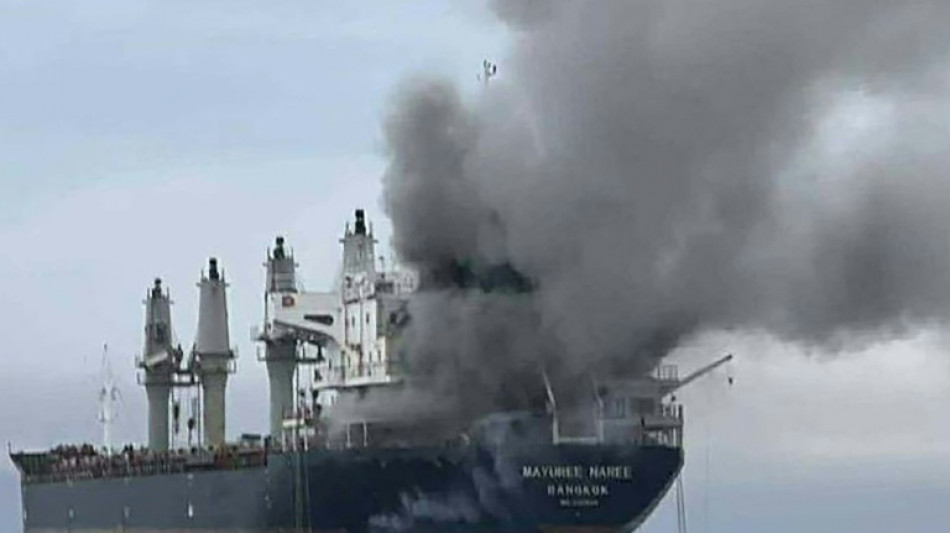
Why convoys cannot fully protect oil tankers from Iran attacks / Photo: Handout - ROYAL THAI NAVY/AFP

The Israeli-US war on Iran has provoked a reaction from Tehran that has effectively choked a large chunk of the world's oil supply, and untangling the blockage will take a regional effort beyond what is currently being proposed, experts have told AFP.
President Donald Trump has repeatedly urged other global powers to send warships to escort convoys of tankers through the Strait of Hormuz, a vital waterway for the world's oil and liquefied natural gas supplies.
Iran has effectively closed the strait since the United States and Israel began a war on the Islamic republic last month, sending global oil prices up by more than 40 percent.
Iran has however shown it has a much wider reach and can disrupt supplies throughout the Persian Gulf and beyond, simply by firing off a clutch of drones or a missile.
Trump has acknowledged the dangers of this kind of attack, at least in the strait.
"It's easy for them to send a drone or two, drop a mine, or deliver a close-range missile somewhere along, or in, this Waterway, no matter how badly defeated they are," he posted on social media at the weekend.
But strategic planners need to look at a much bigger geographical area and consider a much wider array of tools if they are serious about protecting oil tankers, experts have told AFP.
"Treating 'Hormuz security' as a chokepoint-only problem is analytically incomplete," naval analyst Tayfun Ozberk, a former Turkish navy officer, told AFP.
The strait is labelled a "chokepoint" because it narrows to around 24 miles (38 kilometres) as it snakes between the southern Iranian coastline and the Arabian Peninsula's eastern tip, a jutting piece of land shared between United Arab Emirates and Oman.
"The effective threat envelope Iran can generate already extends well beyond the narrows," said Ozberk.
"That matters because traffic is exposed not only during the brief transit of the strait, but during the longer 'funnelling' phase where routes, speed constraints, and predictable lanes increase vulnerability."
- 'Limited protection' -
Iran has carried out attacks on shipping hundreds of miles from the strait since the war began, towards the Iraqi coast on one side and well into the Gulf of Oman on the other.
"Outside the strait, there are risks as long as you're within missile range," said a European military source who requested not to be named.
And even within the strait, there are particular challenges that convoys could struggle with -- for one, the narrowness of the channel drastically reduces the time a warship might have to stop an attack.
"Mounting a navy-escorted convoy through the Strait of Hormuz... is not only very complex but also offers limited protection," researchers Christian Bueger and Jane Chan wrote in a recent paper for RSIS, a Singapore-based defence think tank.
"Not only air defence but also capabilities to intercept speed boats and surface drones, and to detect mines would be required."
The world has been in a similar situation before -- both sides in the Iran-Iraq war of the 1980s targeted commercial ships in the strait.
Sidharth Kaushal, of the UK-based RUSI think tank, told AFP that the United States needed to maintain up to 35 vessels in the area during what became known as the Tanker War.
Yet the capacity of navies to carry out this type of operation has diminished over the years.
Hans Tino Hansen of the Risk Intelligence firm told AFP the number of warships in western navies equipped for a convoy mission had fallen by 75 percent since 1988.
- 'Raise uncertainty' -
One of the thorniest problems a convoy could face is the possibility of sea mines.
Trump said on Monday that US forces had hit all of Iran's mine-laying ships but warned that the devices could be transferred to other vessels.
Turkish expert Ozberk said mines remained Iran's "most strategically efficient lever" because they "raise uncertainty and cost even when they don't sink ships".
Putting these measures in place slows convoys, as specialist vessels take time to clear any devices and they themselves need further protection.
The European military source told AFP if an area is mined "you first have to create safe routes with mine countermeasure vessels, which are very vulnerable and therefore must be protected, and which advance at four kilometres an hour to clear a strip a few hundred metres wide".
"Even then, a convoy has to be preceded by a mine countermeasure vessel to detect any anomaly.
"Within the convoy, frigates must be inserted at regular intervals to deal with air and surface threats."
The source added that if there were no mines "convoys can form more easily and travel at higher speeds, and the frigates can manoeuvre around the ships they are protecting".
The overall complexity of protecting tankers in the wider region means any operation would probably not resemble a traditional convoy at all, RUSI's Kaushal argued.
"Instead, destroyers and aircraft would likely attempt to provide an air-defence network over routes as a whole, while tools like helicopters could provide cover against USVs (surface drones)," he said.
"The tempo of activity needed to make this shield persistent while also prosecuting targets on the Iranian mainland will likely prove highly resource intensive, however."
F.P.Kavanaugh--IP