War-weary Sudanese celebrate as Ramadan returns to Khartoum / Photo: Ebrahim Hamid - AFP

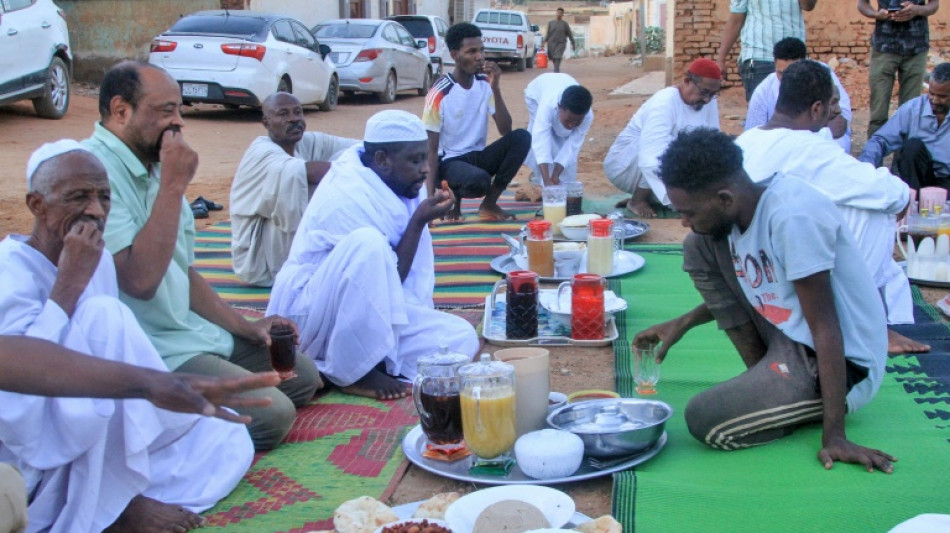
A familiar scene returned to Khartoum as men gathered in the streets of the war-scarred Sudanese capital to break their fast on the first day of the Muslim holy month of Ramadan.
It was here that fighting first erupted in April 2023 between the army and the paramilitary Rapid Support Forces.
The conflict then swept across the country, killing tens of thousands of people and displacing millions.
For close to two years, the Sudanese capital -- composed of the three cities of Khartoum, Omdurman and Bahri -- was ravaged by war until the army recaptured it last March.
Entire neighbourhoods had been besieged, some left in ruins, as rival fighters shot at each other across the Nile River.
"Last Ramadan, there were no more than two families. Today, we are 13 families breaking the fast together, and that's in just one street," said Abdelkader Omar.
The trader had returned home to Omdurman months after being forced to flee the city.
Like many others, he had brought a dish to share with his neighbours, sitting outside on a mat.
Only men were gathered here, with women remaining at home for iftar, the fast-breaking meal.
"Goods are available, but prices compared to wages makes things difficult," said Omar.
Sudan has known only triple-digit annual inflation for years. Figures for 2024 stood at 151 percent, down from a 2021 peak of 358 percent.
The currency has also collapsed, going from 570 Sudanese pounds to the US dollar before the war to 3,500 in 2026 on the black market.
Soaring prices have hit people's pockets as they reduce their purchases of fruit and vegetables at Khartoum's central market.
"People complain about prices, say they're outrageous. You can find everything, but the cost keeps rising," said Mohamed, a market vendor.
Meanwhile, Omar said he was just happy to be home after so long.
"We found the place safe and people back in their houses," he said.
- 'No one is missing' -
Elsewhere in Omdurman, Hassan Bachir laid the table as neighbours rolled out a mat, all waiting for the sun to set.
Bachir, 53, returned last June after fleeing the country.
"Today I went to the Omdurman market to buy what I needed, and given what I'd seen during the war, I didn't expect it to look like this again," he said.
He too has been hit hard by the price hikes but stressed that "Sudanese people help each other out" in many ways, including through community kitchens.
Around him sat other men, each with their own dish.
Glasses of helo-murr, a bittersweet drink made from corn flour, lined the table.
Journalist Othman al‑Jundi, who had stayed in Omdurman during the war, said the city was "completely different" this year.
In 2025, there were "only two families in our street" compared to the 16 back in their homes today, he said.
"Last year we sat here full of worry: a stray bullet could hit us or a shell could fall," recalled Nimeiri al‑Sheikh Taha, whose neighbour's house was struck.
"No one went out alone. We moved in groups."
About 400 kilometres (250 miles) southwest, the war grinds on in Sudan's Kordofan region, where deadly drone strikes have left communities stranded.
But even there, Muslims came together for a meal at sunset.
Ahmed Balla in El-Obeid, the capital of North Kordofan, told AFP by phone he had gathered with 17 families to break his fast.
"Today, despite the security situation and occasional drone attacks, no one is missing."
P.McCurtain--IP