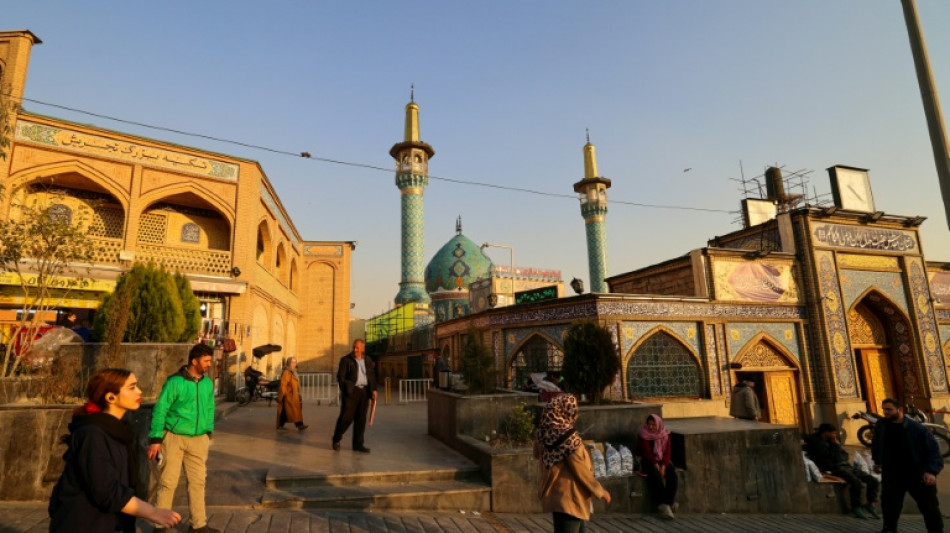
Iranian students rally for second day as fears of war with US mount / Photo: Atta KENARE - AFP

Iranian students gathered for fresh pro- and anti-government rallies Sunday commemorating those killed in recent protests, as fears loomed of renewed conflict with the United States over the country's nuclear programme.
The initial demonstrations were sparked in December by economic hardship in the sanctions-hit country, but quickly expanded into mass anti-government protests that marked one of the largest challenges to the Islamic republic's clerical leadership in years.
US President Donald Trump had initially cheered on the protesters, threatening to intervene on their behalf as authorities launched a deadly crackdown, but his threats soon shifted to Iran's nuclear programme, which the West believes is aimed at developing atomic weapons.
Washington and Tehran have since returned to the negotiating table, but Trump has simultaneously pursued a major military build-up in the Middle East aimed at pressuring Iran to cut a deal.
Following campus rallies commemorating the protest dead on Saturday, the Fars news agency on Sunday published videos of fresh crowds of dozens of people waving Iranian flags and carrying memorial photographs at universities in the capital Tehran.
One showed a rowdy gathering at Sharif University of Technology shouting "death to the shah" -- a reference to the monarchy ousted by the 1979 Islamic revolution -- as they faced off with another group, with men in uniforms between them.
Fars said there had been "tensions" at at least three universities in Tehran where some students chanted "anti-establishment" slogans.
Iran International, a media outlet based outside the country and branded a "terrorist" organisation by Tehran, shared a video on social media of students holding up the pre-revolution flag at Sharif University, as well as videos of rallies at other institutions of higher learning.
A video geolocated by AFP of what appeared to be the demonstration at Sharif University showed a large crowd chanting anti-government slogans as they thronged around students waving the flag of the toppled monarchy.
The authorities acknowledge more than 3,000 deaths in the unrest, including members of the security forces and bystanders, but say the violence was caused by "terrorist acts" fuelled by Iran's enemies.
The US-based Human Rights Activists News Agency (HRANA), however, has recorded more than 7,000 killings in the crackdown, the vast majority protesters, though the toll may be far higher.
- Negotiations -
Representatives of the US and Iran recently met in Geneva for a second round of Oman-mediated nuclear talks, with Iran promising to send a draft proposal for a deal to avert military action in the coming days.
Axios reported on Sunday, citing an unnamed senior US official, that if Iran submitted its proposal in the next 48 hours, Washington was ready to meet again "in Geneva on Friday in order to start detailed negotiations to see if we can get a nuclear deal".
The US has dispatched two aircraft carriers to the region, along with other jets and ships, and has also shored up its air defences in the Middle East.
Trump's chief Middle East negotiator Steve Witkoff said Saturday in a Fox News interview that the president was questioning why Iran had not yet given in to US pressure.
"He's curious as to why they haven't... I don't want to use the word 'capitulated', but why they haven't capitulated," he said.
"Why, under this pressure, with the amount of seapower and naval power over there, why haven't they come to us and said, 'We profess we don't want a weapon, so here's what we're prepared to do'?"
Iran has long denied it is trying to produce nuclear weapons, but insists on its right to enrich uranium for civilian purposes.
- Fears of war -
A previous round of nuclear diplomacy last year was interrupted by Israel's surprise bombing campaign against the Islamic republic.
That sparked a 12-day conflict in June that the US briefly joined with strikes on nuclear facilities
Iran has maintained that it will defend itself in the event of any new attack.
Despite the latest talks, Iranians' fears of a new conflict have grown.
"I don't sleep well at night even while taking pills," Tehran resident Hamid told AFP, saying he worried for his "family's health... my kids and grandchildren".
IT technician Mina Ahmadvand, 46, believes that "at this stage, war between Iran and the US as well as Israel is inevitable and I've prepared myself for that eventuality".
"I don't want war to happen, but one should not fool around with the realities on the ground."
The concerns have prompted several foreign countries to urge their citizens to leave Iran, including Sweden, Serbia, Poland and Australia, which warned "commercial flights are currently available but this could change quickly".
H.Conneely--IP