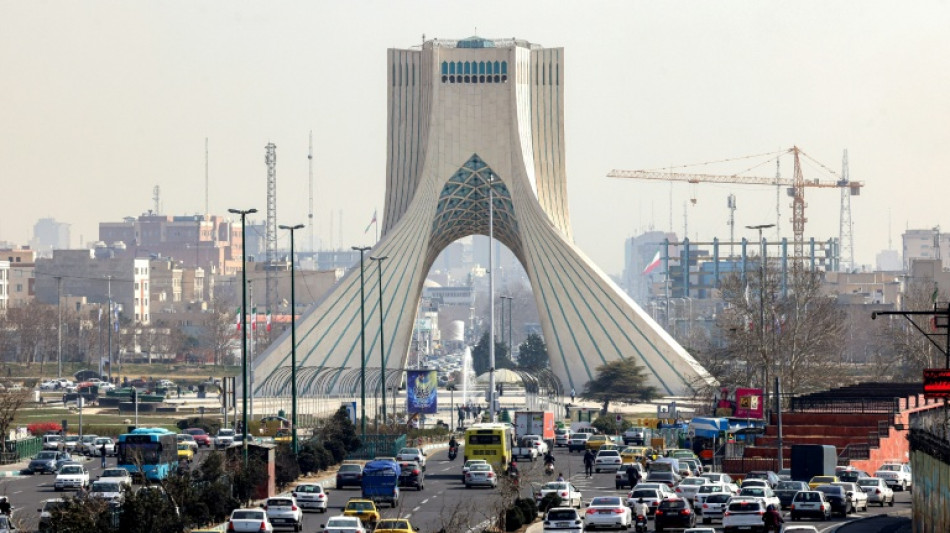
Iran says students must respect 'red lines' after protests / Photo: ATTA KENARE - AFP

Iran offered a muted warning on Tuesday for students who staged anti-government rallies, with the country's leaders under pressure after a recent mass protest movement and threats of US military action over its nuclear programme.
University students kicked off a new semester over the weekend with gatherings in which they revived slogans from nationwide protests against the country's clerical leadership that peaked in January and were met by a deadly crackdown.
On Tuesday, the fourth consecutive day of the campus protests, videos verified by AFP showed two groups facing off in a large hall at a Tehran university -- one waving Iranian flags and the other chanting anti-government slogans -- before scuffles break out.
The day before students had burned the flag that was adopted by Iran's Islamic republic after the 1979 revolution that toppled the monarchy, according to verified videos.
Iranian government spokeswoman Fatemeh Mohajerani, giving the first official reaction to the rallies, said on Tuesday that while students had a right to protest, they must "understand the red lines".
The flag, she added, was one "of these red lines that we must protect and not cross or deviate from, even at the height of anger".
She said Iran's students "have wounds in their hearts and have seen scenes that may upset and anger them; this anger is understandable".
- 'Arrests continue' -
The initial wave of protests began in December, sparked by economic woes in the sanctions-hit country, but soon grew into nationwide demonstrations that crested on January 8 and 9, posing one of the largest challenges to Iran's leaders in years.
The unrest prompted a violent government crackdown that killed thousands of people.
The US-based Human Rights Activists News Agency (HRANA) has recorded more than 7,000 deaths, while warning the full toll is likely far higher.
Iranian officials acknowledge more than 3,000 deaths, but say the violence was caused by "terrorist acts" fuelled by the United States and Israel.
During the protests, the government had sought to walk a line between acknowledging protesters' legitimate economic grievances while condemning so-called "rioters".
Mohajerani said a fact-finding mission is investigating "the causes and factors" of the protests, but rights groups warn the crackdown is ongoing, with tens of thousands of people already arrested.
Videos of students outside multiple universities in the capital on Tuesday showed crowds chanting against the clerical authorities, with many images blurred or only showing hands to hide identities.
"Authorities continue to terrorise the population," as the country reels from last month's crackdown, said Human Rights Watch researcher Bahar Saba in a report released Tuesday.
"Arrests continue and detainees face torture, coerced 'confessions', and secret, summary, and arbitrary executions," she said.
A resident in Tehran told an AFP journalist outside the country he didn't think the campus protests would extend beyond big universities because "most people are still terrified of the brutality of the regime".
He joined the mass protests "due to moral responsibility", he said, but added that he thought "most people won't (join now) because of... the fear of brutal oppression and hope in Trump", referring to a possible US strike.
- US pressure -
The crackdown in January prompted US President Donald Trump to threaten to intervene militarily on the protesters' behalf, though the focus of his threats soon shifted to Iran's nuclear programme, which the West believes is aimed at building an atomic bomb but Tehran insists is peaceful.
Since then, the US has carried out a massive military build-up in the Middle East aimed at pressuring Tehran into cutting a deal, even as the two sides pursue indirect negotiations, set to resume on Thursday in Geneva.
Washington deployed one aircraft carrier group attached to the USS Abraham Lincoln to the Arabian Sea, and a second, that of the USS Gerald R. Ford, has arrived at a US base in Crete en route to the region.
Iran has vowed to retaliate "ferociously" against any attack from the United States, even a limited one, which Trump has publicly acknowledged he is considering.
Iran's Revolutionary Guards, the ideological arm of the military, carried out drills on the shores of the Gulf in their own show of force, state media said Tuesday.
"Very good measures have been designed in various sectors, including missiles, artillery, drones, special forces, armoured vehicles and armoured personnel carriers," Mohammad Karami, commander of IRGC ground forces, told state television.
He said the drills were being conducted "based on the threats that exist", without elaborating.
R.T.Anglim--IP