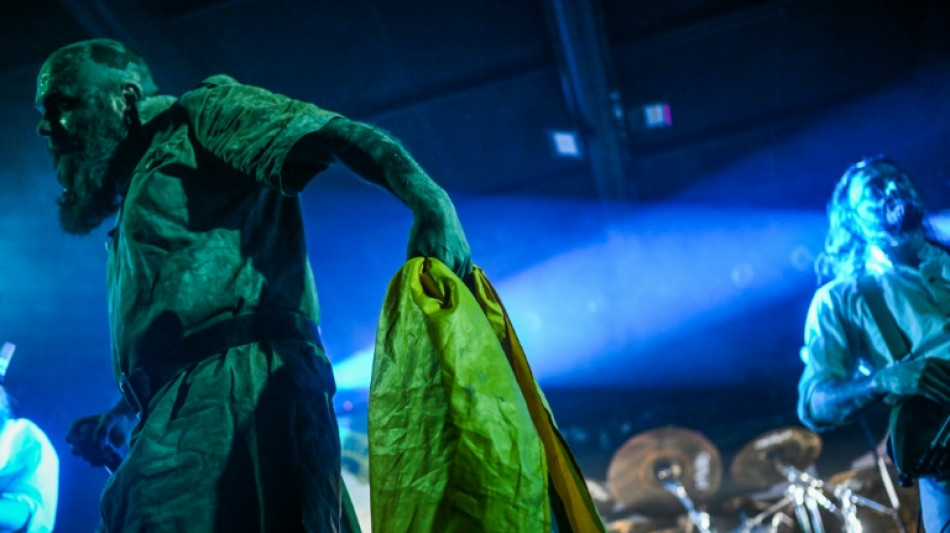
Ukrainian death metal band growls against Russia's war / Photo: Sergei GAPON - AFP

A singer emerges from the grave, his beard covered in mud, head bowed and fist raised as he extends a Ukrainian flag towards the audience: this is his entrance onstage.
Around him, in a concert hall in Warsaw, a shrill guitar tremor rises and falls whilst the drums unleash a barrage of semiquaver notes.
Finally, clad in a costume resembling a butcher's tunic, Dmytro Ternushchak releases guttural, growling death-metal vocals, and proclaims, in English: "One day, the Empire will fall."
Going by the stage name Dmytro Kumar, he is the frontman of 1914, one of the best-known Ukrainian metal bands.
But their career has been upended by Russia's invasion of Ukraine in 2022. The band cancelled a tour in 2023 because they did not have permission to leave Ukraine, required for men aged 23-60.
Having finally obtained the necessary authorisation, 1914 began their first proper tour in six years in Poland, and their political message is amplified.
For Mykyta Dokiychuk, 15, this was his first metal concert.
His family fled Ukraine at the start of the full-scale Russian invasion.
"I love this genre, it fires me up," said the long-haired, bespectacled teenager. He accused Russia, ravaging Ukraine, of seeking to "destroy the Ukrainian people".
During the concert, Dokiychuk moved gingerly. Next to him, a man performed a majestic display of headbanging, his hair flying back and forth to the rhythm like windscreen wipers.
"It's important that we... stand against these imperial ambitions of Russia," said Mikolaj Boratynski, 33, a Polish concertgoer with a thin moustache.
The chorus of his favourite 1914 song encourages people to smash the Russian aggressor.
"It is important for art to address these issues, not just love and beer," agreed Katsiaryna Mankevich, stage name Nokt, a 37-year-old Belarusian who lived under occupation near the Ukrainian capital Kyiv until 2022 before fleeing to Poland.
Herself a metal band singer, she was one of the few women in the audience.
- 'Aberration' -
Kumar, 43, founded the group in 2014, at the beginning of the war between Kyiv and Moscow-backed separatists, in the western Ukrainian city of Lviv.
A former journalist, he spoke to AFP before the show, talking of his love for Polish punk and his loathing of Hungarian Prime Minister Viktor Orban, an ally of Russian President Vladimir Putin.
Kumar's band is dedicated to the First World War. The five members dress as soldiers of the Austro-Hungarian Empire, which, in 1914, controlled the historical region of Galicia where Lviv is located.
Across their four albums, 1914 recreate the horror of World War I. Their tracks are interspersed with poignant period music and film excerpts.
On stage, Kumar either stands still or frantically paces around, clutching his face like a demon or a man in tears.
His lyrics are based on thorough historical research.
He joked that he practised "necrophilia, or as they call it, history".
Kumar said his anthropological obsession was to understand "aberration", how humans revert back to their primal instinct and engage in "its most vulgar form of aggression": war.
- 'Strong Ukrainian spirit' -
Ukrainian soldiers have worn 1914 merchandise whilst attacking on the front line, and have used the band's tracks in videos showing strikes on Russian troops.
Kumar said he was "shocked" when he found this out. But if his music can inspire Ukrainian soldiers, then "well damn, that means I did something useful".
He himself cannot enlist into the army, having had surgery for cancer that still requires him to take medication.
Kumar feels "ashamed" of not being able to fight, he said. He currently refuses to tour in Ukraine, saying he does not have the right to perform in front of people who have truly experienced the trenches.
Like other bands, 1914 are raising money for the Ukrainian army. Kumar is attempting to "open the eyes" of Europeans to the Kremlin's warmongering, showing that Ukraine was the continent's "eastern shield", he said.
Their latest album, "Viribus Unitis", follows the story of a Ukrainian from Galicia in their fight, notably against Russia, in World War I.
At the Warsaw gig, several cries of "Glory to Ukraine" rang out, along with chants against the Russian troops.
Mykyta Dokiychuk cracked a smile.
During the concert, he felt a "strong Ukrainian spirit".
N.Behan--IP