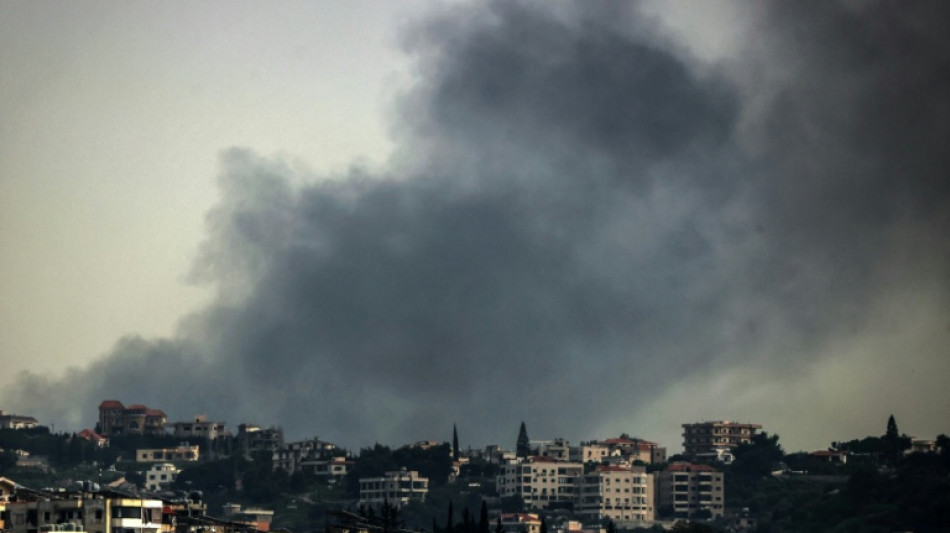
Trump says Iran has agreed to hand over its enriched uranium supply / Photo: MAHMOUD ZAYYAT - AFP

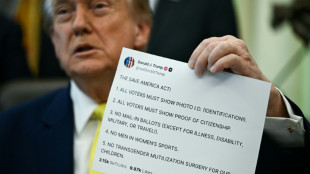
US President Donald Trump said Thursday that Iran has agreed to hand over its store of enriched uranium and that the two sides were "close" to a peace deal to end the war that has engulfed the Middle East.
The United States had earlier threatened to resume airstrikes on the Islamic republic and maintain a naval blockade of its ports if Tehran refused to accept a deal to solve the conflict that broke out on February 28.
At the same time, on another front in the conflict, US President Donald Trump announced that Israel and Lebanon had agreed to a 10-day truce starting on Thursday and said he expected the two countries' leaders at the White House in "four or five days".
Hezbollah lawmaker Ibrahim al-Moussawi told AFP the Iran-backed Lebanese armed group -- which has been fighting Israel since early March -- would respect the ceasefire if Israeli attacks on the militants stopped.
The Lebanese and Israeli prime ministers welcomed the ceasefire, which came days after the US and Iran agreed a separate truce and as Pakistan pursued diplomatic efforts to arrange a new round of talks between foes Washington and Tehran.
Iranian state television on Thursday showed Pakistan's powerful army chief Asim Munir meeting Iran's speaker of parliament, Mohammad Bagher Ghalibaf, who led the Iranian delegation at the first round of talks last week, which ended without a deal.
The Iranian ambassador to the UN later said Tehran was "cautiously optimistic" about its negotiations on ending hostilities with the US and expressed hope for a "meaningful outcome".
US Defense Secretary Hegseth had said Thursday: "If Iran chooses poorly, then they will have a blockade and bombs dropping on infrastructure, power and energy."
Trump later told reporters that "there's a very good chance we're going to make a deal" with Tehran, adding that he would consider going to Pakistan to sign an agreement.
"They've agreed to give us back the nuclear dust," he said, using his name for the enriched uranium stockpile that the United States says could be used to build nuclear weapons.
- No nuclear weapons -
Trump has insisted that any deal with Iran must permanently bar the Islamic republic from acquiring a nuclear weapon.
He launched the war claiming that Tehran was rushing to complete an atomic bomb, an assertion not backed by the UN nuclear watchdog.
Washington has reportedly sought a 20-year suspension of Iran's uranium enrichment programme, while Tehran has proposed suspending nuclear activity for five years -- an offer US officials rejected.
Tehran insists its nuclear programme is for civilian purposes.
Its foreign ministry said Wednesday that Iran's right to enrich uranium was "indisputable", although the level of enrichment was "negotiable".
Also on Thursday, the US House of Representatives rejected a Democratic effort to curb Trump's authority to wage war in Iran.
The vote came as unease over the six-week conflict continued to spread on Capitol Hill, with lawmakers wary of rising costs, an unclear endgame and the risk of a wider war.
- 'Historic crossroads' -
White House Press Secretary Karoline Leavitt had told reporters on Wednesday that further talks between the US and Iran "would very likely" be in the Pakistani capital.
Pakistani foreign ministry spokesman Tahir Andrabi said no date had been set for the next round of talks.
US Vice President JD Vance, who led the first round, has said Iran is being offered a "grand bargain" to end the war and address the decades-old dispute over Tehran's nuclear programme.
Israel's defense minister Israel Katz said: "Iran is standing at a historic crossroads: one path is renouncing the ways of terror and nuclear armament... in line with the US proposal, the other leads to an abyss.
"If the Iranian regime chooses the second path, it will quickly discover there are even more painful targets than those we have already struck."
Shipping in the Strait of Hormuz, through which one-fifth of the world's crude oil normally flows, has been disrupted by Iranian forces since the US-Israeli offensive began and is now the focus of the US blockade.
Washington has sought to turn the screws on Tehran with a blockade of its ports, with US Central Command claiming to have "completely halted economic trade going into and out of Iran by sea".
CENTCOM said it had already turned back 13 vessels that tried to sail out of Iranian ports.
Keeping up the pressure, the United States slapped fresh sanctions on Iran's oil industry on Wednesday, which Treasury Secretary Scott Bessent said targeted "regime elites".
The military advisor to Iran's supreme leader Mojtaba Khamenei also warned that Iran would sink American ships in the strait if the United States decides to "police" the key shipping channel.
burs/amj/jfx
R.Hamrock--IP