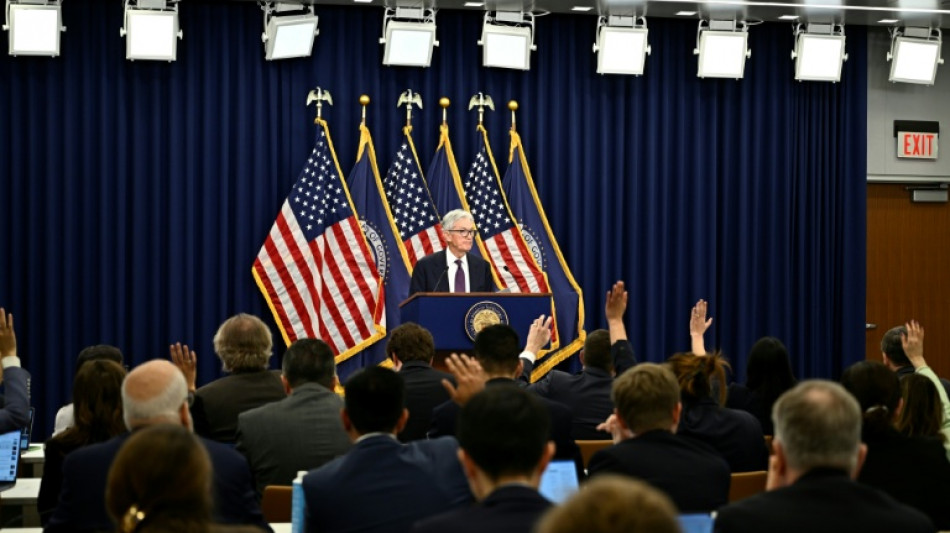
'Majority' of US Fed officials say rate hikes may be needed / Photo: Kent NISHIMURA - AFP/File

A majority of US Federal Reserve policymakers indicated that interest rate hikes could be needed if inflation continued to run persistently above the central bank's two-percent target, minutes of their last meeting released on Wednesday showed.
The Fed's Open Market Committee (FOMC) had voted to keep the key interest rate steady at that meeting, held late last month.
Four of 12 voting officials, however, opposed the outcome, the largest number of dissents since 1992.
Three regional Fed presidents -- Beth Hammack, Neel Kashkari and Lorie Logan -- backed the pause but not language in the Fed statement that signaled an inclination towards interest rate cuts.
One member, outgoing Fed Governor Stephen Miran, voted for an interest rate cut.
The divisions at the Fed will be a key challenge for incoming chair Kevin Warsh, who will be sworn in this week at the White House and who himself has backed interest rate cuts in the recent past.
The meeting's minutes, released after the customary delay of three weeks, revealed divisions on the Fed's path forward.
"In discussing risk-management considerations bearing on the outlook for monetary policy, participants assessed that both upside risks to inflation and downside risks to employment remained elevated," the minutes said.
The Fed has a dual mandate of keeping inflation to a long-term two-percent target while ensuring maximum employment in the world's largest economy.
- Fear of dueling mandates -
US households have been battered by higher-than-expected inflation since the pandemic, with consumer inflation hitting a peak of 9.1 percent in mid-2022.
Last month, that figure hit a three-year high of 3.8 percent, fueled by the economic fallout of US President Donald Trump's war on Iran, which has seen energy prices surge due to Tehran's retaliatory action.
The US unemployment rate has remained relatively steady over the past year, but job growth has see-sawed between expansion and contraction, prompting concerns about labor market weakness.
Some participants of the meeting expressed concern at the possibility of a long-term conflict in Iran leading to a sustained energy price surge, potentially "creating a greater tradeoff between the Committee's employment and inflation goals."
Setting the economy's key interest rate is the Fed's main tool in addressing its dual mandate. Cutting rates tends to boost economic activity and job growth; raising them can cool both inflation and growth.
At the meeting, Fed policymakers "generally judged that the current policy rate was within the range of plausible estimates of its neutral level," meaning one with neither a restrictive nor expansionary effect.
Fed policymakers agreed at the meeting that the situation in the Middle East was "contributing to a high level of uncertainty about the economic outlook."
Before the United States and Israel launched the war in February, markets had priced in two interest rate cuts for 2026, after the Fed held rates steady in January.
Price increases due to the conflict, however, "could necessitate maintaining the current policy stance for longer than previously anticipated," the latest meeting's minutes said.
The Fed is now not expected to change rates until late in the year -- after which the next move is expected to be a hike, according to derivatives marketplace CME Group's FedWatch tool.
R.T.Anglim--IP