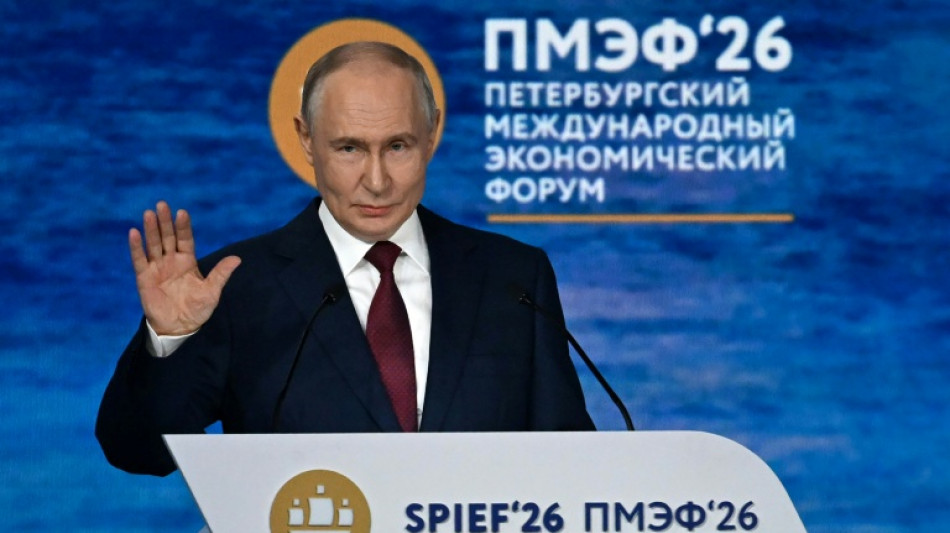
Russian economy has not collapsed, Putin says at key forum / Photo: OLGA MALTSEVA - AFP

The Russian economy has not fallen apart, President Vladimir Putin said on Friday, dismissing Western criticism that his country's economic engine had run out of steam.
The Kremlin's offensive against Ukraine has put Russia's finances under immense strain, with rising prices, tax hikes and two-decade-high borrowing costs hitting many citizens hard.
The Russian economy shrank by 0.2 percent in the first quarter of 2026, its first quarterly slump in three years, amid mounting strain from the war and Western sanctions.
"We, of course, hear criticism from all sides that everything has collapsed," Putin told delegates at the Saint Petersburg International Economic Forum (SPIEF), a flagship investment event sometimes dubbed "Russia's Davos".
"We have descended to the same level at which Eurozone countries have been living through for the past few years," the Russian leader said, adding that Russia was pursuing a "sovereign" economy.
The event comes as Ukraine intensifies its attacks on Russia's vital energy infrastructure -- oil depots, refineries, exporting hubs -- which are threatening to dent Moscow's most important income stream.
In a highly symbolic strike, one attack hit a facility in Saint Petersburg as the conference opened on Wednesday, with arriving dignitaries greeted by a plume of back smoke in the background.
"The Russian economy is entering a stagnation, with high interest rates and high inflationary pressure," Alexander Kolyandr, a London-based Russian economy expert, told AFP on the eve of Putin's speech.
"I don't see the Russian economy entering the 1990s or something similar, it's just a slow degradation of everything," he added.
The Russian government posted an $80 billion budget deficit in the first four months of 2026 -- equivalent to 2.5 percent of annual GDP and more than was planned for the entire year.
- 'Russian Davos' -
Western investors keen to make a buck in Russia's chaotic and fast-growing economy would gather at the SPIEF to strike deals and hobnob with the Russian elite in the early years of Putin's rule.
But since the assault on Ukraine, it has become a marker of the ex-KGB spy's new place in the world.
Drones and machine guns are put on exhibition display.
AFP reporters saw Russian-made humanoid robots walking the venue halls, where stands promoting investment into regions annexed from Ukraine were prominent.
Guests from the likes of China and Saudi Arabia are now the top attendees. Americans and Europeans are few and far between.
Their slimmed-down ranks led by figures such as former Hollywood actor turned Putin-backer Steven Seagal, American conspiracy theorist Candace Owens, and MPs from the right-wing Alternative for Germany party.
- 'Shut down' -
Asked by AFP about Russia's economic woes, Putin had on Thursday channelled the US writer Mark Twain.
"Rumours of my death have been greatly exaggerated," he said, rejecting the idea Russia was on the brink of a full-blown crisis.
But far away from where Putin took the stage on Friday, some small and medium-sized businesses told AFP they were facing closure.
"Basically, we're planning to shut down," Svetlana, the owner of a maternity and kids brand in the Far East city of Khabarovsk, said.
"People are having less kids, tightening their belts, the costs are rising," the 40-year-old told AFP by phone.
Internet blackouts -- imposed by authorities as a means of thwarting Ukrainian retaliatory drone strikes -- mean her card payment terminal is often out of service.
"We are going back to life 18 years ago, when there was no internet or social media," she said.
"I'm tired of worrying about fines because of the new laws and the endless stream of new requirements that keep popping up," she said.
- 'No good solution' -
The "slow degradation" of the economy would be irreversible unless the Kremlin made "political decisions" such as ending the war and restructuring the economy, expert Kolyandr said.
While higher oil prices off the back of the Iran war have increased Russia's revenues, it has not been to the extent needed to refill the state budget, he added.
Labour shortages are also biting, with some 30,000 men a month being recruited for the war.
"There is no good solution," Kolyandr said.
"They will continue to kick the can for as long as possible."
burs/phz
J.Malbrough--IP