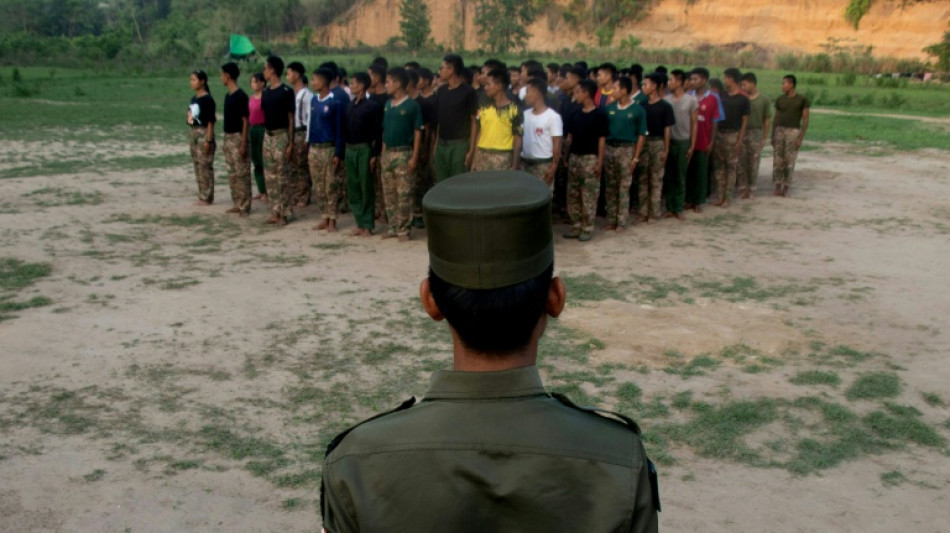
Jungle spirit: Myanmar fighters try to keep hope alive / Photo: STR - AFP

Clad in camouflage uniforms, young guerilla fighters laughed and joked despite a series of military setbacks as they walked to their makeshift parade ground deep in the Myanmar jungle.
In a dusty clearing they lined up to salute the red and white flags of the pro-democracy People's Defence Forces (PDFs) that fled the towns and cities to take up arms against the junta after a 2021 military coup.
Around 100 fighters are based at the secret camp, most of them wearing the peacock symbol of the Mandalay PDF, one of the biggest and best-organised of the scores -- possibly hundreds -- of PDFs in the country.
Five years into the civil war, the camp's wooden structures were set up in the central region of Sagaing after a retreat from Mandalay, and the parade ground doubles as a football pitch, some fighters playing barefoot as their comrades watch.
In one barracks the men sleep side by side on a long raised platform, each recruit's space marked out only by a folded blanket, a rucksack and an assault rifle.
After the opposition's earlier successes, the Myanmar military has advanced on numerous fronts, and some of the ethnic rebel groups that helped the youngsters have been neutralised through China-brokered ceasefires.
Authorities activated conscription legislation in February 2024 to replenish the military's depleted ranks, bolstering its manpower advantage.
Skate, a 25-year-old who joined the Mandalay PDF to avoid being forcibly recruited into the army and is now a squad commander, admitted that "many people are unhappy with the current situation".
"People say things like 'Your revolution is going to fail; you won't be able to bounce back'," he told AFP.
"Even our soldiers themselves sometimes feel this way."
Monitor ACLED says there have been more than 100,000 conflict-related deaths on all sides since the coup.
Skate -- who asked to be identified only by his nom-de-guerre for security reasons -- lamented "so many losses -- the lives of the comrades we fought with, as well as the civilians who were displaced by the war".
"But it also gives us the motivation to overcome these difficulties," he insisted.
- 'Walk our own path' -
After the coup, the PDFs found common cause with the ethnic armed organisations who have for decades fought central rule in Myanmar, relying on them for weapons, ammunition and training.
Mon Mon Nway Oo, one of a handful of women in the camp, was with the rebels who captured and controlled the northern ruby-mining town of Mogok.
But they had to pull back as their allies, the Ta'ang National Liberation Army, agreed to a withdrawal in late November under a China-mediated deal.
"To be honest, I feel sad about losing territories like that after having achieved it," said the 24-year-old.
"We don't understand some of the military matters," she added. "I only knew that we had to retreat."
As well as personnel numbers, the military has overwhelming superiority in both heavy weaponry and airpower with Chinese- and Russian-supplied jets.
And while the rebels were first to adopt drones on the battlefield, many say the military has overtaken them in that technology too.
But Nay, a 33-year-old PDF fighter, said their forces have a key advantage over the military.
"We started this revolution with empty hands; now we have weapons and troops," he said.
"In terms of morale, they are no match for us," he went on.
"This is because we organise and revolt with a spirit of defiance and a refusal to accept injustice."
A.Hanbury--IP