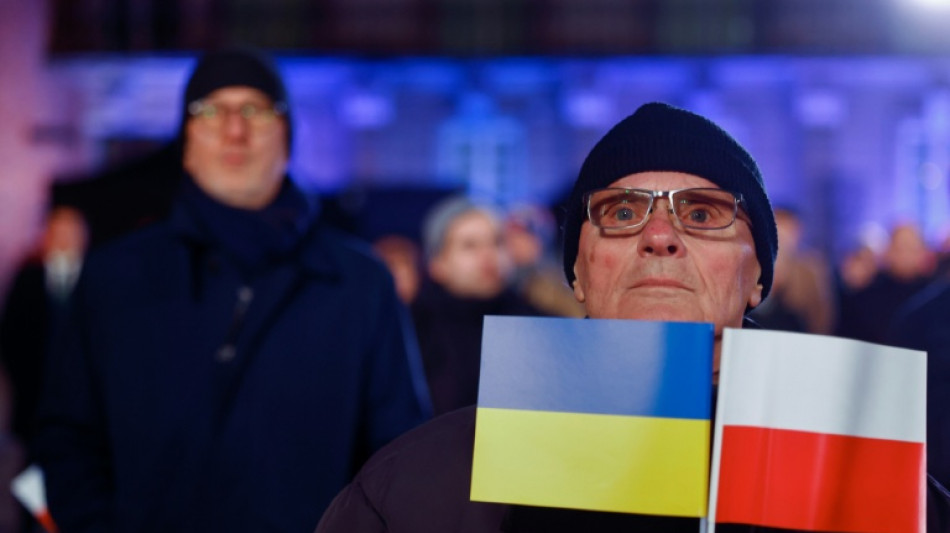
Ukrainian men in Poland face legal limbo / Photo: Wojtek Radwanski - AFP

Thousands of Ukrainian men in Poland face declining living standards and rising uncertainty, but going home means risking being sent to the front and death.
Ukrainian men who fled mobilisation to go to the neighbouring country are caught between politics and war -- and now face legal limbo.
On one end, Poland is toughening its policies on Ukrainian refugees. On the other, Kyiv is upping the pressure to mobilise more men, in the fifth year of Russia's invasion.
In a hostel on the outskirts of Warsaw, teenager Dmytro longed to go home.
"If I could, I'd pack my suitcase right now and leave by foot for Ukraine," the 18-year-old told AFP.
"But I have no future there."
He was 17 when he left his town in central Ukraine, fearful of being sent to the battlefield where hundreds of thousands have died on both sides.
"I thought that if I did not leave before my 18th birthday, I'd be finished," Dmytro said.
He now lives outside the Polish capital in the hostel, with some 100 other Ukrainian men, who mostly work in factories, warehouses and for delivery companies.
Their future is shrouded in doubt.
Poland -- which hosts around one million Ukrainian refugees -- ended special support measures for those displaced by the war in March, after Warsaw elected nationalist president Karol Nawrocki.
Since then, Ukrainians have faced stricter rules -- similar to those for other foreigners in a country with one of Europe's toughest migration policies.
- 'Worried' -
"It's hitting the most vulnerable groups and it's a deep disgrace for the Polish state," said Anna Tatar, a representative of Polish anti-racism NGO "Never Again".
The situation is especially precarious for men escaping the front -- who Poland has in the past argued should not be granted protection.
Volodymyr, who lives in the same hostel as Dmytro, entered Poland illegally three years ago to escape mobilisation.
Like many, the 50-year-old is awaiting the outcome of his residency application.
"I'm worried because no one knows what will happen next," he said.
Ukraine, which mobilises some 30,000 men every month, is also tightening the screws.
Viktoria Korzhova, a member of a Ukrainian law firm in Poland, said she had seen an increase in Ukrainians asking for help to legalise their status since March.
- 'Risk of losing their lives' -
Last month, the European Commission announced plans to exclude Ukrainian men aged 23 to 60 from its temporary protection programme.
The bloc said the decision was taken at Ukraine's request.
But Andriy Gaidutsky, a Ukrainian migration expert, predicted the move would push Ukrainian men to apply for long-term residency in Europe.
"If people used to leave for economic reasons, today many men leave due to the risk of losing their lives or their health," he said.
Some men have risked their lives to escape the front -- crossing the Carpathian mountains or swimming across rivers to Romania -- while others have legal exemptions allowing them to leave Ukraine.
Adding to their uncertainty, Kyiv has since last year restricted men abroad from accessing consular services unless they update their military records -- a task many avoid, fearing mobilisation.
Vadym, 31, worries about renewing his soon-expiring Ukrainian passport.
"I'll have to think about it," he said, nervously.
Even those who left Ukraine legally feel the pressure.
As the carer of his disabled mother, Andriy was allowed to accompany her out of Ukraine, but recalled tense moments at the border.
"The Ukrainian border guard did not want to let me through, even though I had the right to."
- 'Why are you not at the front?' -
On top of their legal problems, the men also face growing anti-Ukrainian sentiment in Poland -- made worse by a recent diplomatic spat between the neighbours over World War II events.
More than half of Poles say their attitude towards Ukraine has become more negative since the row, according to pollster SW Research.
Dmytro said he felt it at the factory where he works.
"I have a colleague who steers every conversation back to Ukrainians and how much we're bothering them."
As the war drags on, the men repeatedly face the same question from strangers: "Why are you not at the front?"
The Never Again group said it had recorded a rise in anti-Ukrainian incidents -- "including hate speech and physical aggression" -- since nationalist Nawrocki took office last year.
"When the war ends, I will go home and this will be finished," Volodymyr said.
"I've had enough."
N.Behan--IP