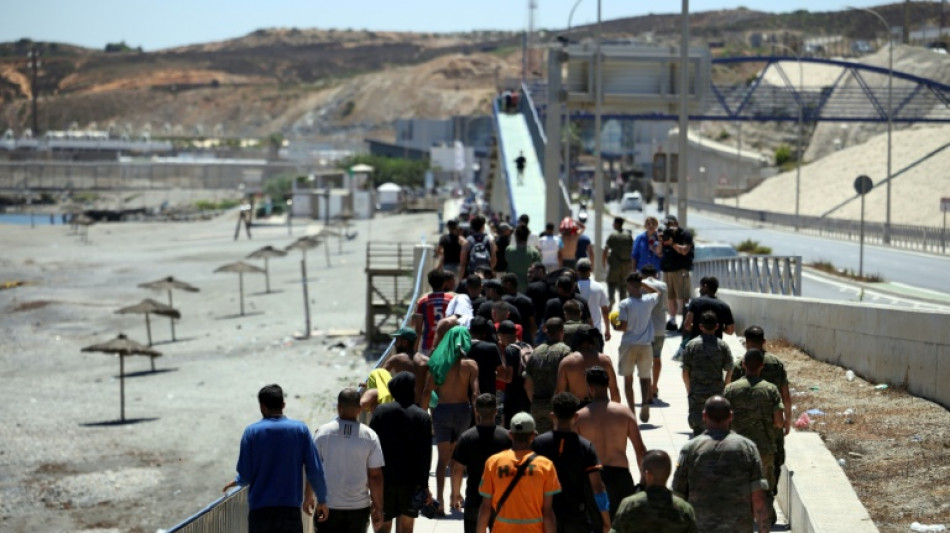
EU nations patch things up after Ceuta migration discord / Photo: Henry NICHOLLS - AFP

Spain and fellow EU nations moved to bury the hatchet Tuesday after a mass influx of migrants into the North African enclave of Ceuta laid bare fault lines on migration within the 27-nation bloc.
Addressing reporters following three hours of talks with the bloc's interior ministers, EU migration chief Magnus Brunner said the crisis had "tested" Europe's border security, its "resilience to disinformation" and "solidarity" among member states.
"Europe, I think, has definitely passed this test," said the commissioner. "It was a crisis, but now fortunately, it has been resolved."
Spain moved swiftly to send migrants back from Ceuta, confirming Tuesday that of 72,000 people who entered the enclave from Morocco last week, all but 2,000 have returned.
But the sight of tens of thousands of people streaming into Ceuta -- with dozens dying in the attempt -- was pounced on by right-wing voices both sides of the Atlantic as evidence Europe is under siege from "uncontrolled" immigration.
And it left Madrid isolated on the EU stage, with 22 of 27 countries backing a joint call for firmer action against illegal immigration -- and suggesting Spain's migration policies were part of the problem.
The government of Prime Minister Pedro Sanchez has backed a more open approach to migration than many EU counterparts, namely hardliners like Italy and Denmark which advocated suspending Spain from the Schengen free-travel area over the Ceuta crisis.
Madrid firmly rejected that notion -- in any case impossible under EU law -- with Sanchez writing to the heads of the EU's institutions at the weekend to berate the "selfish" stance of fellow member states.
- 'Communication' falls short -
The stage was set for an acrimonious showdown on Tuesday but ultimately capitals sought to play down their divisions, with Spanish Interior Minister Fernando Grande-Marlaska calling the tone "absolutely constructive".
"All member states, without exception, affirmed their solidarity with Spain," echoed French minister Laurent Nunez -- whose country had distanced itself from the 22-nation initiative it saw as exploiting the crisis for political ends.
In the hardline camp, Denmark declared itself "very satisfied" with Madrid's crisis response, although its immigration minister Morten Bodskov warned "these events show that it is absolutely crucial that we have control over the EU's borders."
Italian Prime Minister Giorgia Meloni has openly attacked Madrid's migration policies, specifically a push to grant legal status to undocumented migrants already in the country.
But her interior minister Matteo Piantedosi began his address by expressing "sincere solidarity" with Madrid -- before doubling down on a tough line.
Spurred by Italy among others, the EU has significantly tightened its migration rules in recent months, including by allowing member states to send failed asylum seekers to so-called "return hubs" located outside the bloc's borders.
According to a transcript shared by his office, Piantedosi argued "the time has now come" for EU countries to set up return centres on the model of a deal between Rome and Albania.
And he suggested the EU should use trade measures to pressure Morocco -- which he accused of "failing to cooperate on repatriation, enjoys significant advantages in its trade relations with Europe."
A statement following the meeting said ministers commended Spain for its "swift and effective" response, noting that "there has been no onward movement to mainland Spain or other member states."
But they also conceded "communication" at such moments could be made "more coherent", in a tacit acknowledgement that on that front, the European response this time around fell short.
E.Smith--IP