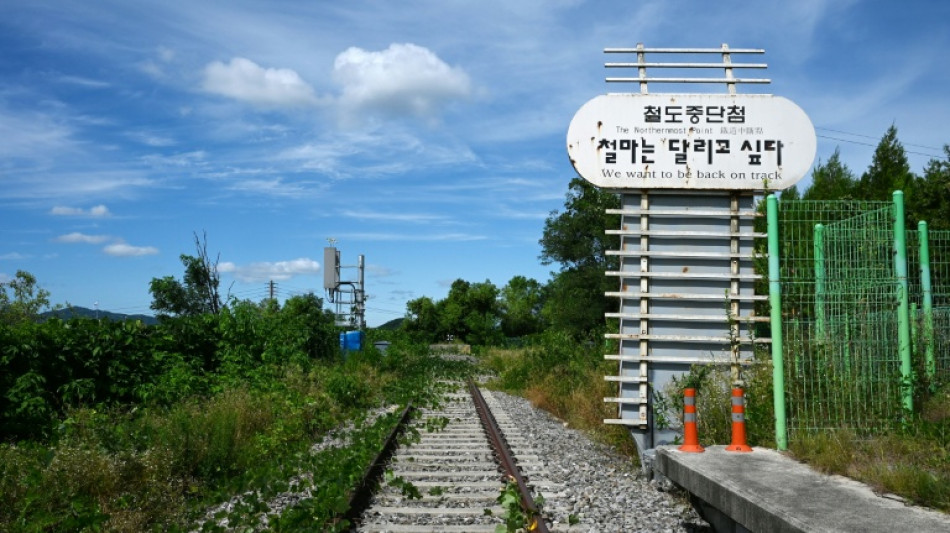
Train to nowhere? South Korea's lonely push for peace with the North / Photo: GREG BAKER - AFP

Near the heavily fortified frontier dividing the Korean peninsula, the abandoned Woljeong-ri station is being recast as a symbol of South Korea's hopes to reconcile with the North.
But plans to reconnect South Korea's northernmost station to the rail network come at an awkward moment, as Pyongyang ignores Seoul's overtures while the South's old ally Washington pursues its own talks with Pyongyang.
A turbulent few days have raised doubts about the role of South Korea in any diplomatic push, despite President Lee Jae Myung's dovish line on the North since taking power last year.
US President Donald Trump abruptly scaled back annual military drills with Seoul this week, calling them "inappropriate and hostile" towards the nuclear-armed North.
He also berated South Korea for not helping in his war against Iran and said he would meet the North's leader Kim Jong Un this year.
North Korea then fired around 10 short-range ballistic missiles on Thursday, while Kim's powerful sister mocked Seoul's "master-servant" relationship with Washington.
The developments have overshadowed the Lee administration's outreach, including the Woljeong-ri project aimed at "eventual" reconciliation.
The modest station -- originally located inside today's demilitarised zone (DMZ) -– once sat on a line linking Seoul to Wonsan, but was destroyed during the 1950-53 Korean War. It was reconstructed at its current site in the border town of Cheorwon in 1988.
It is now an attraction for visitors to the nearby DMZ separating the two countries, and the line's former terminus -- Wonsan -- lies in North Korea.
Its history, however, underscores how vulnerable such hopes are to the politics of the peninsula.
Work began in 2015 but ground to a halt just a year later after North Korea's fourth nuclear test.
The latest reboot inspires more scepticism than hope for some in Cheorwon.
"It seems like they keep trying to reconcile with North Korea (through the railway project), but from our point of view, it isn't really practical," said resident Moon Jae-yong, 70.
- Lonely push for peace -
South Korea's reconciliation programme eventually aims to restore rail links, such as Woljeong-ri, with the North.
Lee has also said he is ready for talks with Pyongyang without preconditions, including on formally ending the Korean War, which concluded with an armistice.
His unification minister said in July that Seoul had shifted from prioritising denuclearisation to curbing the expansion of North Korea's nuclear programme.
But Pyongyang -- emboldened by support from traditional ally China, and Russia, whose invasion of Ukraine it is backing -- has been unmoved.
It has repeatedly declared itself an "irreversible" nuclear state and labelled Seoul its "most hostile" enemy.
The US leader may be trying to revive diplomacy to record a foreign-policy win ahead of November's midterm elections, with many voters disenchanted by his intervention in the Middle East.
That has sidelined Seoul, with Lee voicing respect for Trump's decision and pledging to "do his utmost" to support his peacemaking efforts.
South Korea is "reasonably afraid that it gets sidelined -- China, Russia and now America are all engaged with Pyongyang in different ways, while Seoul is not," Vladimir Tikhonov, Korean Studies professor at the University of Oslo, told AFP.
"So, Seoul is desperate to get some opening with North Korea. But it can do very little, so far."
- Impossible dream? -
That leaves the rail project standing as a symbol of South Korea's lonely push for peace.
Along the disused line from Woljeong-ri towards Baengmagoji station to the south -- the section to be restored under the peace project -- vegetation crowds both sides of the tracks, nearly swallowing a stone wall.
"The iron horse wants to run," a sign reads, alongside a phrase in English: "We want to be back on track."
Preparing infrastructure in the South now could save time if inter-Korean links are eventually restored, said Lim Eul-chul, a professor at Kyungnam University.
"But realistically, it is virtually impossible under the current circumstances, and everyone knows that," he told AFP.
With few options on North Korea, Seoul has turned to projects it can "pursue unilaterally", Lim said.
The project also aims to boost tourism along the border, where residents face frequent disruptions and security risks.
Pyongyang sent trash-filled balloons and broadcast unsettling noises across the border during the administration of Lee's hawkish predecessor, Yoon Suk Yeol.
Kim Sun-hee, 70, described them as "like scraping cement, or even ghost-like noises. It was really frightening".
A bombed-out locomotive from the Korean War remains near Woljeong-ri station as a reminder of the division.
It is "heartbreaking to see", said visitor Ahn Seung-hyun.
H.Conneely--IP