War-bruised Myanmar finds relief in bareknuckle bloodsport / Photo: Sai Aung MAIN - AFP

In a country consumed by conflict, a sport defined by brutality dominates: Myanmar's lethwei martial art, where headbutts are encouraged and knock-out blows are the aim of the game.
"I can't live without fighting," said 19-year-old Su Luck, who enters the ring under the paradoxical pseudonym "Peace Prize".
"I have never once considered giving up this passion," she said.
Lethwei is traditional Burmese boxing, distinct from Thai kickboxing because head blows are permitted and fighters compete bareknuckle, fists protected only with wraps of thin gauze.
It is known as the "Art of Nine Limbs" because each contenders' two fists, elbows, knees and feet as well as head are considered viable weapons to take down opponents.
In a country where many have been dragged into the five-year-old civil war, the popularity of a tooth-and-nail national sport is obvious to some.
"It's not only a sport, it's our art of self-defence," said veteran fighter and coach Saw Kyaw Thein Tuu.
"Guns are of no use if they run out of bullets on the battlefield," the 73-year-old added.
"This art will help them defend and fight enemies anytime."
But others find the ring not a training ground for hostility but a space for the zen of self-improvement.
"Even when I take hits to the face, I accept it as my own weakness, as a sign that I still have more to learn," said Su Luck, who dreams of becoming a schoolteacher.
She is a rising star in the sport, which is dominated by men.
"I never think I've become perfect," Su Luck added.
- Nation on the ropes -
On parade grounds across Myanmar, legions of youngsters march in formation either for the military or the array of armed groups who have battled it since the 2021 coup ousted democratic leader Aung San Suu Kyi's government.
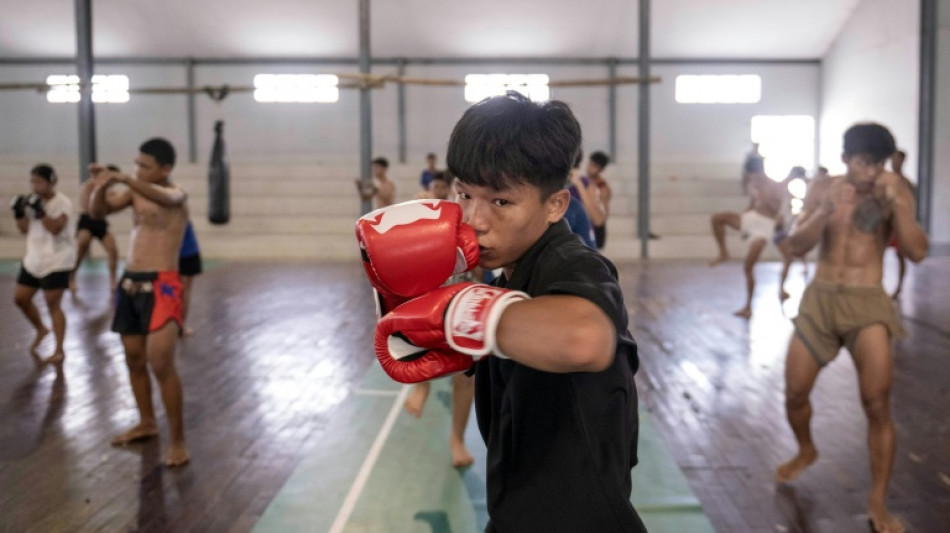
But at the start of the monsoon season in Hpa-an -- capital of Karen state, Myanmar's lethwei heartland -- more than 100 teenagers and young adults rose for dawn to march in devotion to the sport.
Under limestone karsts that dagger the brightening sky, they lap a race track to raise their pulses before shifting to a sports hall filled with battered punch bags.
Inside, coaches from the Karen State Traditional Lethwei Organisation hector them to jab harder and kick higher in sparring sessions leaving them sopping with sweat.
For many, their hero is Burmese-American fighter Joshua Van, the reigning champion in the flyweight division of the internationally renowned Ultimate Fighting Championship.
But his title in the mixed martial arts competition was won without lethwei's signature moves, banned for being too dangerous.
Fighter Moe Hein is refining those methods during a two-week training camp at Hpa-an, though he does not relish when they inflict pain.
"In some matches when the other person gets battered, bruised or cut because of me, I don't feel happy inside," the 22-year-old said.
"But since it's a sport, I'll try to hit him and he'll try to hit me too. That's just how it is."
- 'Dignity and respect' -
Myanmar's civil war, Asia's deadliest active conflict, has killed more than 100,000 people on all sides, according to ACLED, an organisation monitoring media reports of violence.
Coach Saw Kyaw Thein Tuu said he has witnessed lethwei deaths too, as it pushes the boundaries of sport.
"I have been to 200 matches in my life and there were six people killed. We had to deal with the police," he said.
"Our Myanmar traditional lethwei should not be considered a sport," he mused.
"It should be thought of as another type of game."
In Karen state, more than 260,000 people are living displaced, according to United Nations data.
Armed factions vie for control of the border state's lucrative trade routes to Thailand and internet scam centres, which have thrived in the chaos of wartime.
Along the six-hour drive from the commercial capital Yangon to Hpa-an are more than a dozen checkpoints manned by the military, militias or armed non-uniformed men.
Despite its brutality, Su Luck said lethwei offers another way.
"Compared to fighting outside, it's more honourable to fight in the ring," she said.
"On the stage, when two fighters challenge each other and compete it has more dignity and respect."
A.Hanbury--IP