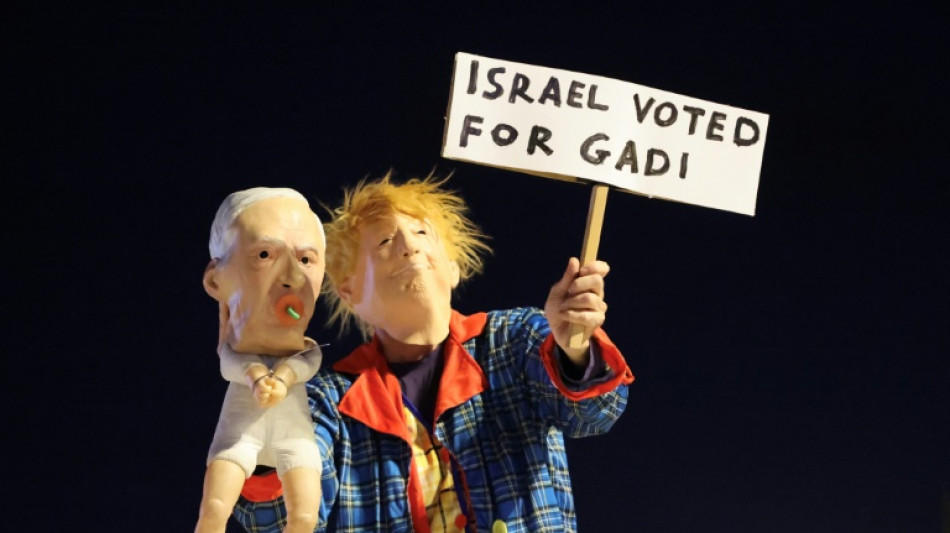
Israeli protesters demand opposition ally with Arab parties to oust Netanyahu / Photo: Jack GUEZ - AFP

Hundreds of Israelis took to the streets on Saturday to urge the opposition to ally with Arab parties to oust Prime Minister Benjamin Netanyahu, who has gone on the offensive against the minority group's leaders.
Arab-majority parties made major gains in Tuesday's election, fuelled by anger over rhetoric targeting the community from Netanyahu's hard-right government, but opposition chief Gadi Eisenkot has not decided whether to seek a coalition with them.
Joining a rally in Tel Aviv, Ayelet Raz said that the Arab community, which accounts for around 20 percent of Israel's population, had a right to political participation.
"It's the last chance for real change," the 60-year-old psychologist said, warning that Netanyahu, Israel's longest-serving prime minister, was a "great manipulator".
"We need to give peace a chance," she said. "Otherwise we'll have this bloodshed forever."
Tuesday's election was inconclusive, with neither bloc reaching a majority in Israel's 120-seat parliament.
Jewish-majority parties opposed to Netanyahu, known by his nickname Bibi, won 48 seats, while two Arab-majority parties, Raam and the Joint List, secured a combined 19 seats.
An alliance between the two camps would potentially give the anti-Netanyahu bloc a comfortable majority of 67 seats, but the idea is opposed by some parties in the opposition bloc.
"Arabs and Jews will only win together" and "There is a majority for change" read some of the signs held by around 500 protesters in Tel Aviv.
"67 -- United we stand, divided we get Bibi" and "Why not, really -- unless we are racist?" read some of the placards at the 100-strong rally in Jerusalem.
Arab parties have only once formally sat in an Israeli government, when Raam leader Mansour Abbas joined a short-lived coalition that lasted from 2021 to 2022.
He has voiced a willingness to do so again.
The Joint List's Yousef Jabareen, meanwhile, has told AFP he is willing to support Eisenkot in parliament without joining his government, citing, among other concerns, the war in Gaza.
- Opposition division -
Eisenkot, 66, a former military chief and political novice, largely shares Netanyahu's views on security issues including Gaza, which Israel has reduced to rubble since the Hamas attack on October 7, 2023.
Eisenkot reiterated on Saturday that he would only form a "Zionist government" whose members commit to the "recognition of Israel as a Jewish, democratic and liberal state" and to the "recognition of Hamas as a terrorist organisation", conditions that Arab leaders have previously refused to accept.
While he has said he does not want a government dependent on Arab lists, Eisenkot has not explicitly rejected their external support.
"I want them (the opposition bloc) to go ahead to be brave and do the right thing," said demonstrator Sharon Balaban, 55, a video artist in Jerusalem.
Yair Golan, leader of the left-wing Democrats has enthusiastically supported the prospect of a government backed by Arab parties, saying it would be racist to exclude them, and on Thursday met Abbas.
But Avigdor Liberman, leader of the right-wing anti-Netanyahu Yisrael Beitenu party, has said he will not enter a coalition that relies on Arab parties, even for external support.
"Whoever wants to rely on supporters of terrorism, let them. Yisrael Beiteinu will not be there," he wrote on Facebook on Friday.
- Arabs 'are for Hamas' -
On the sidelines of the demonstration in Tel Aviv, more than 100 Netanyahu supporters staged a counter-protest.
"It's the Right, or Palestine," they chanted, repeating a slogan from Netanyahu's campaign.
"The two Arab parties are for Hamas", said Rebecca Schindler, 60. "They want to make Israel an Arab country."
Nava Rehavia, 70, called on Eisenkot and Liberman to join a Netanyahu-led coalition and said: "The Arabs did not win, because they stole the election."
Netanyahu sought to raise allegations of electoral fraud during voting day, saying Arab parties had been caught with envelopes of cash.
Police said they had arrested three suspects, but the election commission described the incident as an isolated local case.
Netanyahu later raised allegations that Arab politicians improperly received support from Qatar.
Collaboration with Arab parties would be "a disaster for Israel", Netanyahu posted on social media on Saturday.
President Isaac Herzog is expected to grant a party leader a mandate to form a government within 28 days by Thursday, with a possible 14-day extension.
The negotiations come as Netanyahu and US President Donald Trump have hinted at a new attack on Iran, which could help Netanyahu run out the clock until new elections.
U.Dennehy--IP