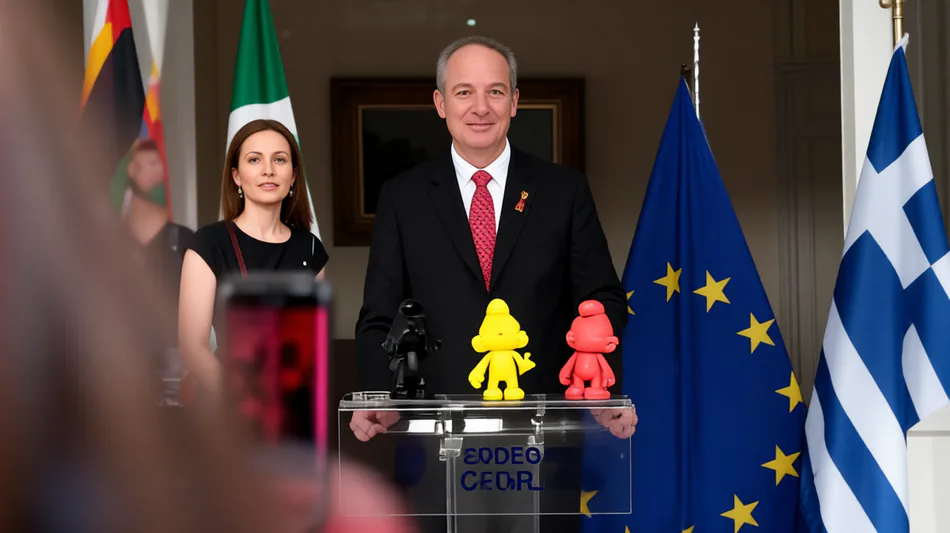
Belgian Ambassador Marks King’s Day in Athens Amidst Strong Bilateral Trade Ties

Belgian Ambassador Marc Calcoen hosted an official King’s Day reception at the embassy residence in Athens on Friday, using the occasion to underscore the robust economic and diplomatic partnership between Belgium and Greece. The event brought together diplomatic corps and Greek officials to celebrate shared commitments to multilateralism and international law.
The Embassy of Belgium in Athens hosted an official reception at the ambassadorial residence on Friday to commemorate King’s Day, a traditional Belgian celebration that serves as a focal point for the kingdom’s annual diplomatic observances in Greece.
Ambassador Marc Calcoen addressed invited guests, including members of the diplomatic corps, Greek officials, and representatives of the local community, emphasizing the shared commitment of Belgium and Greece to multilateralism, international cooperation, and adherence to international humanitarian and maritime law. The gathering highlighted ongoing bilateral relations between the two European Union and NATO member states across political, economic, and cultural spheres.
During his formal address, Ambassador Calcoen underscored the alignment between Brussels and Athens on foundational principles of global governance. He stated that Belgium, in common with Greece, has consistently acted as a steadfast defender of international cooperation, international law, international humanitarian law, the law of the sea, and multilateralism. These remarks situated the ceremonial occasion within the broader framework of European and international diplomatic priorities shared by both nations.
The observance of King’s Day, known in Belgium’s three official languages as Koningsdag in Dutch, Fête du Roi in French, and Festtag des Königs in German, is held annually on November 15. While the date is not designated as a general public holiday for the private sector in Belgium, federal government institutions and public offices close for the occasion, and diplomatic missions abroad regularly host formal receptions to mark the day.
The tradition dates back to 1866, during the reign of King Leopold II, who established the celebration on November 15. The date corresponds to the feast day of Saint Leopold in the German liturgical calendar, chosen to honor the name of Belgium’s first monarch, King Leopold I, who took the constitutional oath in Brussels on July 21, 1831, following Belgium’s independence.
Throughout Belgian history, the observance has undergone minor adjustments in nomenclature. Between 1944 and 1950, during the regency of Prince Charles, Count of Flanders, the Belgian government referred to the occasion as the Feast of the Dynasty. Following the accession of King Baudouin I, the celebration was formally renamed King’s Day in 1952. In accordance with long-standing Belgian royal protocol, the reigning monarch and their spouse—currently King Philippe and Queen Mathilde—do not attend the official ceremonies in Belgium, as custom dictates that the sovereign should not participate in celebrations honoring themselves. Instead, other members of the Belgian royal family attend the traditional morning Te Deum thanksgiving service at the Cathedral of St. Michael and St. Gudula in Brussels, followed by a formal ceremony at the Belgian Federal Parliament.
Direct diplomatic relations between Belgium and Greece were formally established in 1874. Over the subsequent century and a half, bilateral ties have become deeply integrated within shared European and transatlantic institutional frameworks. Both nations are full members of the Council of Europe, the European Union, and the North Atlantic Treaty Organization (NATO), where they coordinate on European policy, regional security, and international legal standards.
In recent years, high-level diplomatic exchanges have reinforced institutional cooperation between the two countries. In May 2022, Their Majesties King Philippe and Queen Mathilde of the Belgians conducted an official state visit to Greece at the invitation of the Hellenic Republic, accompanied by federal ministers and the minister-presidents of Belgium’s regions and communities. Parliamentary diplomacy has also remained active, with the Greece-Belgium Parliamentary Friendship Group meeting with Ambassador Marc Calcoen at the Hellenic Parliament in Athens in February 2026 to discuss ongoing legislative and bilateral cooperation.
In previous public statements regarding his tenure in Athens, Ambassador Calcoen has noted that Belgium and Greece share a common outlook on democratic values and international affairs as longstanding members of the European Union and NATO. He has also highlighted Greece’s role as a factor of stability in the Southeastern Mediterranean region and noted the parallel historical experiences of both nations in navigating complex European geopolitical landscapes.
Alongside diplomatic and political coordination, economic and commercial exchanges form a substantial component of Belgian-Greek relations. According to bilateral trade data compiled by the Observatory of Economic Complexity (OEC), total annual exports from Belgium to Greece reached $2.35 billion in 2024, while Greek exports to Belgium totaled $621 million during the same period, resulting in a bilateral trade surplus of $1.73 billion for Belgium.
Pharmaceuticals, automotive products, and refined energy commodities dominate the trade flow between the two European Union member states. Belgium’s primary exports to Greece include packaged medicaments, which accounted for $293 million in 2024, alongside passenger vehicles, vaccines, immunological products, and refined petroleum. Conversely, Greece’s leading exports to the Belgian market consist of refined petroleum, valued at $112 million in 2024, packaged medicaments at $45.4 million, raw tobacco at $32.8 million, as well as processed agricultural goods and industrial utility meters.
Beyond traditional goods trade, Belgian enterprises have increasingly engaged with Greece’s technology and services sectors. In an April 2026 interview with the Greek newspaper To Vima, Ambassador Calcoen noted that Belgian firms have emerged as active investors in Greece’s expanding technology sector, citing the availability of a highly educated Greek workforce.
Cultural and academic institutions provide additional channels of cooperation between Brussels and Athens. The Belgian School at Athens, which traces its origins to the 1960s and received official accreditation from the Greek state in 1985, operates as one of the 17 foreign archaeological institutes in the Greek capital. The institution conducts archaeological excavations, historical research, and academic exchanges across Greece, contributing to the preservation and study of classical heritage.
Human and social links between the two countries are further sustained by a substantial Greek diaspora community residing in Belgium, estimated at between 15,000 and 26,000 people, alongside Belgian expatriates, researchers, and professionals living in Athens and across the Greek islands. Events such as the annual King’s Day reception at the Belgian ambassadorial residence in Athens serve to convene these diplomatic, commercial, academic, and community networks in recognition of the bilateral partnership.
The Embassy of Belgium in Athens manages bilateral diplomatic, consular, political, and economic affairs for the Kingdom of Belgium across both Greece and Cyprus. Ambassador Marc Calcoen leads the diplomatic mission in Athens, serving alongside Consul and Deputy Head of Mission Hans Heeman and First Secretary for Political and Economic Affairs Tina Tindemans. The embassy’s broader regional diplomatic network also includes Defence Attaché Kris De Donder, who is based in Rome, and Liaison Officer Eva Mielnicki, stationed in Tirana.
In addition to its primary diplomatic mission in the capital, Belgium maintains a network of seven honorary consulates throughout Greece to support Belgian citizens and facilitate regional commercial and cultural links. These honorary consular offices are located in Corfu, Heraklion, Mytilene, Patras, Piraeus, Rhodes, and Thessaloniki. Greece maintains its reciprocal diplomatic representation in Belgium through its embassy in Brussels, which has operated since 1945.
T.Gallagher--IP