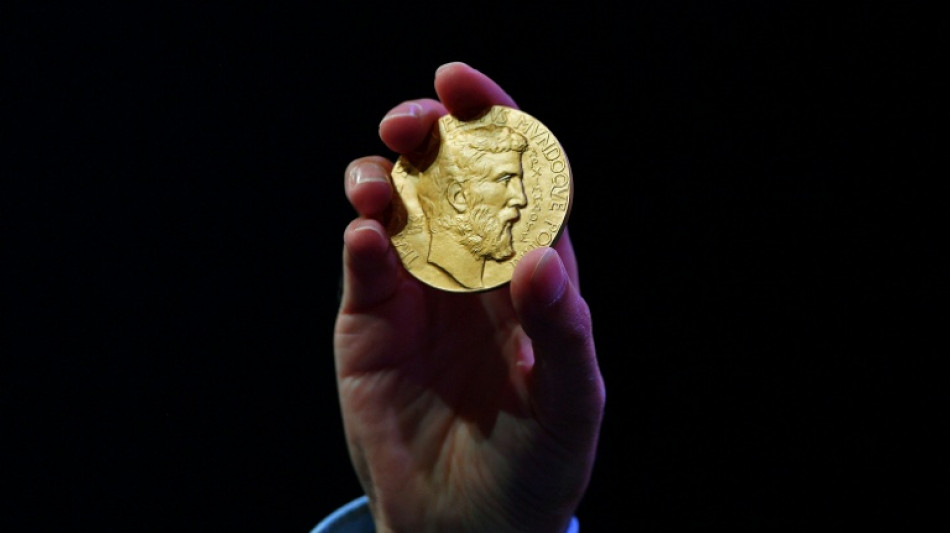
Fields medal awarded to four young mathematicians / Photo: CARL DE SOUZA - AFP/File

The Fields medal, known as the Nobel prize of mathematics, was awarded Thursday to four people -- two Chinese citizens, one American and one Canadian.
The honor -- a recognition of outstanding discoveries by researchers under the age of 40 that is bestowed by the International Mathematical Union -- comprises 15,000 Canadian dollars (USD $17,000) and a gold medallion bearing the likeness of Archimedes.
Chinese mathematicians Hong Wang and Yu Deng, American John Pardon, and Canada's Jacob Tsimerman are this year's recipients of the prize, which is presented every four years.
Wang is only the third woman to receive the honor since its inception in 1936.
The 35-year-old from China teaches in France as well as the United States, at New York University.
She follows in the footsteps of Maryam Mirzakhani of Iran, who won the prize in 2014, and Ukrainian mathematician Maryna Viazovska, who won it in 2022.
Wang is being honored for work that notably led to a solution. Last year, she solved a mathematical puzzle that had stumped experts for more than a century.
The conjecture was originally posed by Japanese mathematician Soichi Kakeya.
"In 1917, Kakeya asked a very simple question: if you rotate a pencil so as to turn it completely around, what is the smallest area it sweeps out?" Wang told AFP.
Along with her colleague Josh Zahl, she finally found an answer by analyzing what would happen if the pencil was floating in three-dimensional space, rather than on a flat table.
"If this conjecture fascinates people so much, it is because this kind of phenomenon shows up naturally in problems from very different fields," Wang said.
- 'That's beautiful' -
The parallel win for Deng, who teaches at the University of Chicago, underscores China's growing prominence in the math world in recent decades.
The United States, which holds the record for the most laureates, was also represented by the 37-year-old Pardon. And Tsimerman, 38, rounds out the quartet.
The medals were awarded during the opening ceremony of the International Congress of Mathematicians in Philadelphia.
A specialist in complex algebraic geometry and analytic number theory, Tsimerman said his interest in mathematics started with a puzzle his grandfather told him.
"It was a little puzzle about a toaster. If you have a toaster but it's broken, so both slots only toast one side of the bread, and you have three pieces of bread that you want to fully toast both sides of, how many times must you use the toaster?" he said.
He recounted the sense of wonder he felt after discovering the answer.
"I was like, 'That's beautiful,' and I was basically hooked," he said in a video shown at the ceremony.
- AI risks -
This year's event takes place at a unique moment for the field, which is increasingly being shaken up by advances in artificial intelligence.
In recent months, some AI models have demonstrated the ability to produce high-level mathematical proofs, to the astonishment of many experts.
These feats are promising -- but also carry risks, a group of mathematicians warned in June.
In a document entitled the "Leiden Declaration," the group outlined scientific and ethical concerns regarding AI, calling for the establishment of frameworks and safeguards.
And they're not always on point, the group said.
"Current automated techniques can produce plausible but unreliable (or even incorrect) arguments which are difficult to distinguish from correct mathematical proofs," read the declaration.
"All of these challenges arise at a moment when the consequences of large-scale investment in artificial intelligence are being widely discussed in regard to warfare, mass surveillance, political disruption, and environmental damage."
H.Conneely--IP