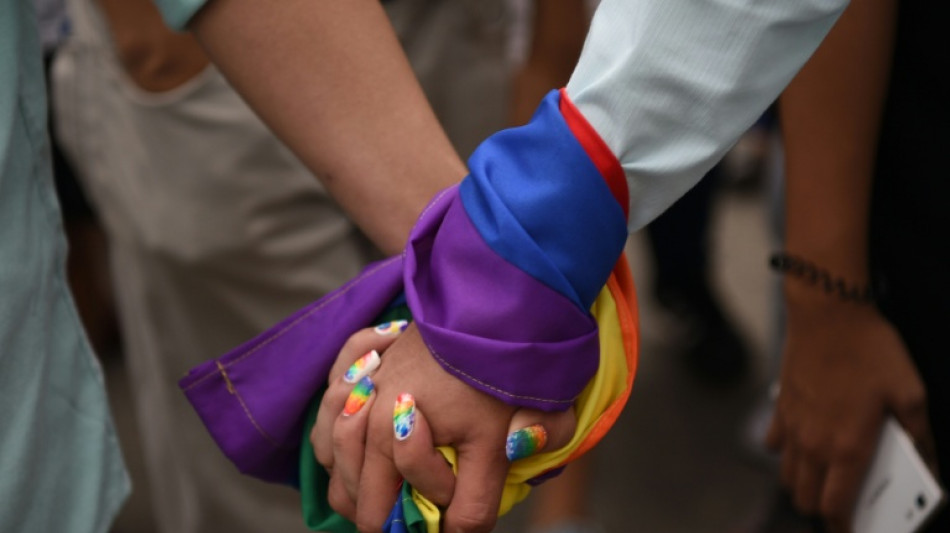
Online same-sex romance series embrace AI 'freedom' / Photo: TED ALJIBE - AFP

Fed up with the dearth of same-sex love stories on Philippine screens, Vee Camallere created her own show using artificial intelligence, a technology described as a mixed blessing by LGBTQ campaigners.
The web developer's campus romance and crime thriller series "Featherweight" has been watched hundreds of thousands of times on YouTube and TikTok since its March debut.
Experts warn that AI tools, trained on massive and often biased datasets, risk perpetuating stereotypes and misinformation about minority groups.
But they have also become a means for LGBTQ expression and connection, especially in conservative parts of Asia.
AI "allows creators to produce stories independently and share them instantly", said Camallere, a 34-year-old lesbian who used several cutting-edge image generators to make "Featherweight".
"Filipino queer stories can reach international viewers faster, more frequently, and with more creative freedom," she told AFP.
In the first episode, student Daisy scrambles at rush hour to catch a jeepney, the country's most common form of public transport.
She later meets another student, Mika, in the library, as a Filipino love song heralds the start of their passionate saga.
"There still isn't a lot of content available for audiences who want to watch these kinds of stories" in the Philippines, said Camallere, whose show is part of the "Girls' Love" genre popularised in manga and anime.
"It looks so real," said "Featherweight" fan Jhessy Aquino, 28.
If AI helps produce similar series, "it can help normalise queer relationships" in the country, Aquino said, particularly for women-centred narratives that are "often less visible".
- 'Stereotypical' -
"LGBTQ people and other historically underrepresented groups are finding global connection and important information through AI," Sarah Kate Ellis, head of campaign group GLAAD, said in a report published in June, which is LGBTQ Pride Month.
"But we also face a dangerous reality," she warned.
"Platforms and products disproportionately fail us in basic safety, data privacy, transparency, and accuracy -- including perpetuating factually incorrect information about our lives."
The report cited research including a 2024 investigation by tech site Wired that found AI systems would often portray LGBTQ people as young, white, and with purple hair.
There are several high-profile LGBTQ celebrities in the Philippines, and Boys' and Girls' Love series have been growing in popularity for several years.
But same-sex marriage is illegal in the largely Catholic country, and no national law bans discrimination based on sexual orientation or gender identity.
That is also the case in South Korea, where it would be "a major turning point if individual creators can use AI to produce high-quality queer content on par with existing K-dramas", said the maker of "The Summer of You", a self-published, AI-generated Korean Boys' Love series.
AI can be excellent "for visualising the voices of minorities who have struggled to cross the threshold of mainstream media", said the creator, who asked to use the pseudonym Tender Frame.
Like Camallere, they used AI image generators to carefully curate each scene in the story.
But they also hired real voice actors to give a more "nuanced" performance by understanding the narrative as a whole.
- On the margins -
AI is also helping breathe life into queer histories that have been little acknowledged or risk being erased.
Singaporean photographer Aik Beng Chia used an image generator to depict the lives of transgender people in the city-state's Bugis street, then known as a red-light district, in the 1970s and 80s.
"In Asian societies where LGBTQIA discourse often remains on the margins, AI may help create alternative visual archives, speculative histories, and new forms of public discussion," said National University of Singapore researcher Jiayu Chen, who has studied Chia's work.
"But responsible use also requires transparency, contextualisation, and care," she added.
Chen urged tech firms and governments to work with "communities with diverse backgrounds and expertise" to develop more culturally sensitive AI tools.
Established producers of non-AI same-sex art and entertainment had varied views on the new generation of "Girls' Love" and "Boys' Love" titles.
"Using AI to tell queer stories can feel unfair to existing creatives who are already capable of crafting these narratives with honesty and depth," Natts Jadaone, writer of the film "Rookie", told AFP.
June Green, a trans, non-binary Korean artist, said that while AI content can serve a meaningful purpose, "when the primary goal is attention, engagement, or commercial success, queer lives and experiences can too easily become something to package, market, and consume."
AI in its current form limits production quality, noted non-binary Filipina filmmaker Dolly Dulu.
"But if they are telling those stories for a specific reason that resonate so much for them and they have no other means, who are we to prevent them from telling their stories their own way?"
M.McClendon--IP