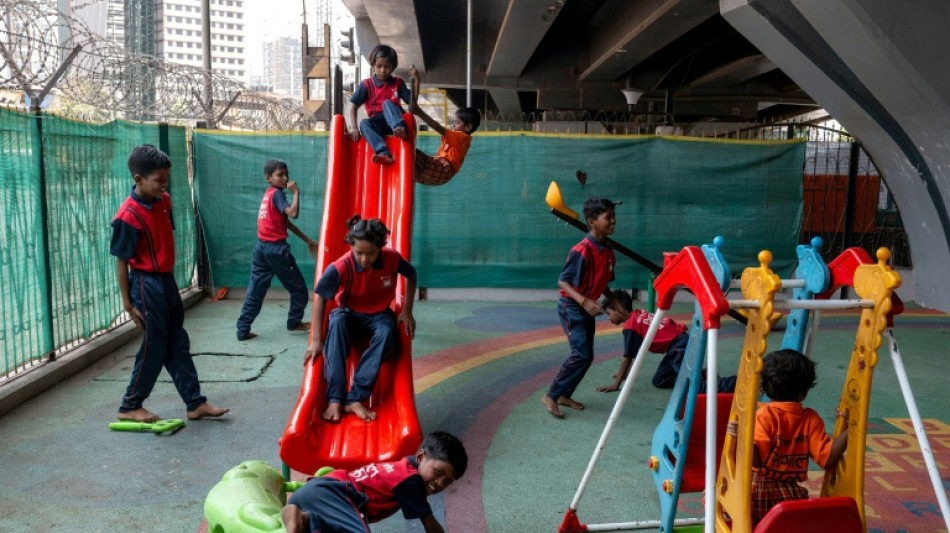
India flyover school offers lifeline to street children / Photo: Punit PARANJPE - AFP

Beneath a busy flyover in India's financial capital Mumbai, a row of pastel-coloured shipping containers houses an unlikely school serving some of the city's most marginalised children.
Despite laws guaranteeing free schooling for children aged six to 14, poverty and migration continue to keep many out of classrooms, particularly in sprawling cities like Mumbai where many families survive through low-paying informal work.
Crippling urban poverty also means young children selling knick-knacks on streets are still a fairly common sight at crowded traffic intersections in big Indian cities.
But the non-profit that runs the free school is determined to educate its underprivileged cohort, many of whom come from homeless families that barely eke out a living.
Wedged between gleaming skyscrapers and busy roads, the "Signal Shala", or traffic signal school, caters to several dozen children who have been left out of the formal education system, according to Bhatu Sawant, founder of the initiative.
"These children can't go to (a regular) school. So (I thought) let's do this. Let's bring the school to them," Sawant, 45, told AFP.
India runs one of the world's largest public school systems, but government data for 2024-25 still identified nearly 1.2 million children as "out of school", a catch-all categorisation that covers both those who have never been to school or dropped out.
- Free meals -
For Sawant, India's government-run schools are simply "not flexible enough for these children", while private ones charging exorbitant fees are out of the question.
The signal school operates from repurposed air-conditioned containers placed on a narrow strip of land beneath a flyover, where classes and play unfold amid the constant rumble of traffic overhead.
Its approach is tailored to the realities of street life.
Every morning, the school bus drives through the cramped lanes of Mumbai's slums, picking up students -- a lifeline for parents who can't afford transportation.
When the children file in, the first order of business is a shower, as many have no easy access to bathing facilities.
Lockers are provided for books and uniforms that otherwise cannot be kept safe or clean while living in slums or on the streets.
Three meals are provided free, with school hours longer than normal.
Classes are split by ability rather than age, with teachers adapting lessons for children who may never have held a pencil before.
Older students are also taught basic skills like sitting still, speaking clearly and staying focused.
The challenges are particularly acute when it comes to kids from the semi-nomadic Pardhi community, who often do not speak the local language.
"When the children came here, they didn't know what the days of the week were, what the 12 months were or what the seasons were," said teacher Tejasvi Borade, as the container walls rumbled from the steady stream of cars passing above.
- Robotics and AI -
For the students, the school serves as a sanctuary from the harshness of the real world.
"I feel very happy seeing the school bus," said 12-year-old Pooja Pawar, whose parents take on odd jobs at construction sites.
"The school clothes feel nice. The breakfast is good... In school, we make cake... and dance."
For others, it represents an opportunity long denied.
Balaji Laxman, who once sold tissues at traffic lights to earn a few hundred rupees -- the equivalent of several US dollars -- a day, said the classrooms represent a chance to imagine a different future.
"I want to become a doctor," Laxman, 12, said with a shy smile.
While the school steers many children towards vocational pathways, Sawant said the broader ambition is to ensure they are not left behind in a rapidly changing world.
"We have to prepare them for the 21st century," said Sawant, who has set up two similar schools on the outskirts of Mumbai which have robotics labs among other facilities.
"They should know robotics, AI, computers, 3D printing," said the educator who relies on private and corporate donations for funding, with the government helping with the infrastructure.
"Everything that elite class children are doing well in, they should know all of that."
M.Dowling--IP