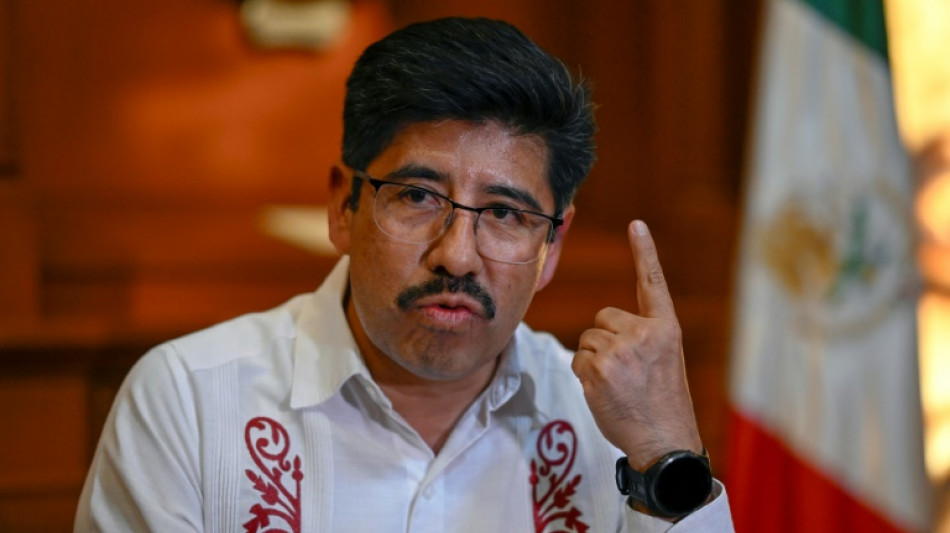
Mexico's Indigenous chief justice hits back at discrimination / Photo: Alfredo ESTRELLA - AFP

Mexico's Supreme Court chief justice told AFP he faces discrimination on a daily basis over his Indigenous roots.
Hugo Aguilar is the first Indigenous Mexican to preside over the country's top court in 168 years.
He attributes the achievement to a voting reform championed by the leftist government, which sees judges elected by a popular vote.
Having secured the most support in the first-ever ballot of its kind last year, Aguilar follows in the footsteps of Benito Juarez, Mexico's first Indigenous president who also led the Supreme Court from 1857-1858.
"Without the reform, I wouldn't be here," said the 53-year-old, who hails from San Agustin Tlacotepec, an Indigenous Mixtec town in Oaxaca state.
Before, "the most I could do was set foot in the building," he said during an interview with AFP -- his first with an international outlet since taking office.
Wearing a traditionally embroidered white shirt, Aguilar has dedicated his life to Indigenous causes.
He calmly rejects accusations that he is a pawn of leftist governments under ex-leader Andres Manuel Lopez Obrador and current President Claudia Sheinbaum.
''If I were...I would have been a minister five or six years ago," Aguilar said, adding that attacks on him focus on his appearance rather than his work.
"The criticism directed at me is (because I am) Indian," he said, referring to his Indigenous background, saying that his identity makes detractors think "he has no prospects, no ability, no knowledge, no aptitude."
- No one is 'unreachable' -
Not a huge fan of photos, the judge posed awkwardly in front of Juarez's portrait, calling him an "inspiration and a guide."
Along with experts, the Mexican opposition criticized Sheinbaum's reform for politicizing the judiciary.
Political parties did not partake in the election, but some complained that the governing camp pushed some candidates, including Aguilar.
He voiced strong opposition to any politicization of his court.
"Everyone thought the court was going to step into the realm of judicial activism, issuing rulings with no legal basis...That is completely out of the question," he insisted.
He urged patience with the reform, acknowledging how challenging it is to root out the corruption that blights Mexico's justice system.
"We are starting with this," Aguilar said. "We have to acknowledge that there's a set of deeply ingrained habits that are hard to break."
The justice also highlighted the court's achievements under his mandate, including a reduced backlog of cases and a more accessible system.
He recalls with fondness a childhood marked by caring for and communing with nature, and says he has every intention of returning to that lifestyle one day.
"My mother told me that the day I change will be the day I don't return to the village," he said.
Social status "shouldn't make us unreachable," he added.
T.P.MacNamara--IP